Stakeholders vs Shareholders: Understanding the Key Differences
In the world of business and finance, two terms frequently come up: stakeholders and shareholders. While both are integral to the success of a company, they represent different groups with distinct interests and relationships to the organization. Understanding the nuances between stakeholders vs shareholders is crucial for anyone involved in business, from employees and managers to investors and policymakers. This article will delve into the specific definitions, roles, and importance of each group, highlighting the key differences between stakeholders and shareholders.
Defining Stakeholders
Stakeholders encompass a broad range of individuals, groups, or organizations that can affect or be affected by a company’s actions, objectives, and policies. Essentially, anyone with a vested interest in the success (or failure) of a business is considered a stakeholder. This includes, but is not limited to:
- Employees: Their livelihoods depend on the company’s performance.
- Customers: They rely on the company for products or services.
- Suppliers: They depend on the company for revenue and business opportunities.
- Communities: The company’s operations can impact the local environment and economy.
- Governments: They collect taxes and regulate the company’s activities.
- Creditors: They provide loans and expect repayment.
The interests of stakeholders are diverse and can range from fair wages and safe working conditions to high-quality products and environmental responsibility. A company’s ability to effectively manage its relationships with its stakeholders is often a key indicator of its long-term sustainability and success. [See also: Corporate Social Responsibility Initiatives]
Defining Shareholders
Shareholders, also known as stockholders, are individuals or entities that own shares of stock in a corporation. By purchasing shares, shareholders become part-owners of the company and are entitled to a portion of its profits and assets. Shareholders invest capital in the company and, in return, expect a return on their investment, typically in the form of dividends or capital appreciation.
Unlike stakeholders, the primary interest of shareholders is typically financial. They want the company to be profitable and increase in value, thereby increasing the value of their shares. Shareholders have the right to vote on important company matters, such as the election of board members and major corporate decisions. This gives them a degree of control over the direction of the company. [See also: Understanding Stock Options]
Key Differences Between Stakeholders and Shareholders
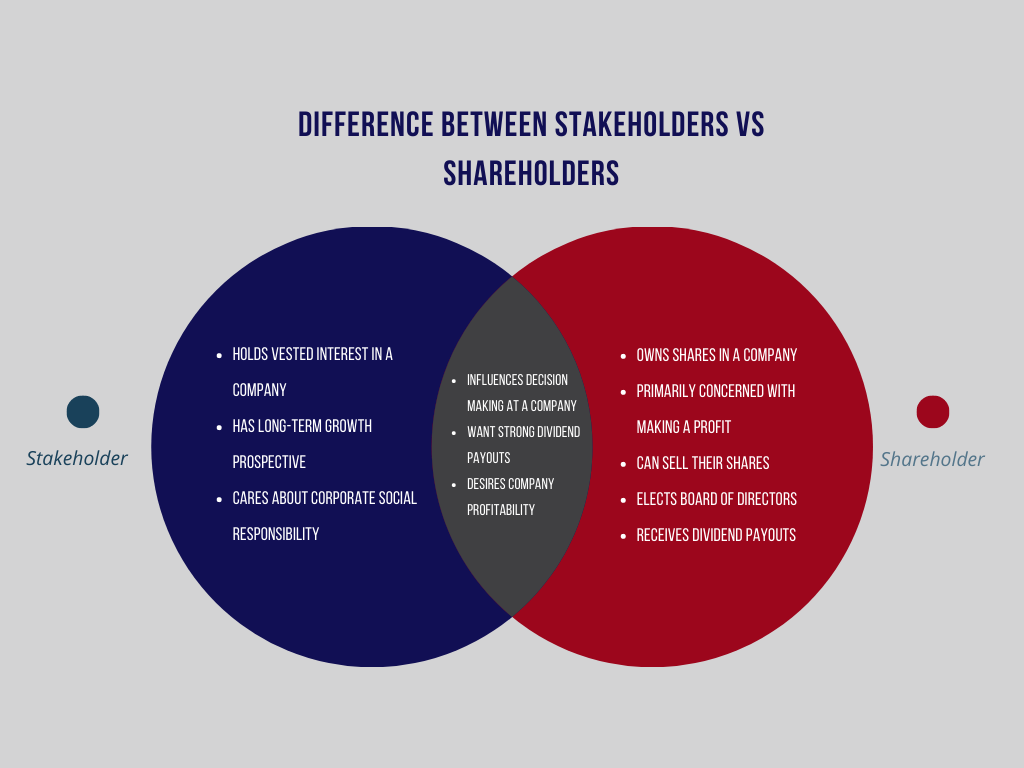
The core difference between stakeholders and shareholders lies in their relationship to the company and their primary interests:
- Relationship: Stakeholders have a broader, more encompassing relationship with the company, based on a variety of interests, while shareholders have a direct financial relationship based on ownership of stock.
- Interests: Stakeholders have diverse interests, including financial, social, and environmental concerns, while shareholders are primarily concerned with the financial performance of the company.
- Investment: Shareholders invest capital in the company, while stakeholders may invest time, effort, or resources in the company’s success.
- Control: Shareholders have voting rights and can influence company decisions, while stakeholders may have limited or no direct control.
To illustrate these differences, consider a hypothetical scenario: A manufacturing company decides to relocate its factory to a different country to reduce labor costs. This decision would likely benefit shareholders by increasing profitability. However, it could negatively impact stakeholders such as employees who lose their jobs, the local community that suffers from economic decline, and suppliers who lose a major customer. This scenario highlights the potential conflicts that can arise between the interests of stakeholders and shareholders.
The Importance of Balancing Stakeholder and Shareholder Interests
While the traditional view of corporate governance prioritizes shareholder value, there is a growing recognition of the importance of considering the interests of all stakeholders. A company that focuses solely on maximizing profits for shareholders may neglect the needs of other stakeholders, leading to negative consequences such as employee dissatisfaction, customer complaints, environmental damage, and reputational harm.
A more sustainable and responsible approach involves balancing the interests of stakeholders and shareholders. This requires companies to:
- Engage with stakeholders to understand their concerns and expectations.
- Incorporate stakeholder interests into decision-making processes.
- Communicate transparently with stakeholders about the company’s performance and impact.
- Develop strategies that create value for both shareholders and stakeholders.
By prioritizing stakeholder engagement, companies can build stronger relationships, foster trust, and create a more sustainable and equitable business environment. This, in turn, can lead to improved financial performance and long-term success. [See also: Ethical Business Practices]
Examples of Stakeholder vs Shareholder Impact
Consider the following examples to further illustrate the impact of decisions on stakeholders and shareholders:
- Environmental Policies: Implementing sustainable environmental policies may require upfront investment, potentially impacting short-term shareholder profits. However, it can benefit stakeholders by reducing pollution, conserving resources, and enhancing the company’s reputation. In the long run, it can also benefit shareholders through increased brand loyalty and reduced regulatory risks.
- Employee Benefits: Offering competitive salaries and benefits packages can attract and retain talented employees, benefiting stakeholders by providing them with job security and financial stability. While this may increase operating expenses, it can also benefit shareholders by improving employee productivity and reducing turnover.
- Customer Service: Investing in excellent customer service can enhance customer satisfaction and loyalty, benefiting stakeholders by providing them with a positive experience. This can also benefit shareholders by increasing sales and revenue.
These examples demonstrate that decisions that benefit stakeholders often have a positive impact on shareholders as well, and vice versa. A company that prioritizes the well-being of its stakeholders is more likely to create a sustainable and profitable business in the long run.
The Future of Stakeholder and Shareholder Relations
The relationship between stakeholders and shareholders is evolving. There is a growing recognition that companies have a responsibility to consider the interests of all stakeholders, not just shareholders. This shift is driven by several factors, including:
- Increasing awareness of social and environmental issues.
- Growing demand for corporate social responsibility.
- The rise of impact investing, which seeks to generate both financial returns and positive social or environmental impact.
- The increasing power of social media, which allows stakeholders to voice their concerns and hold companies accountable.
As a result of these trends, companies are increasingly adopting a stakeholder-centric approach to business. This involves actively engaging with stakeholders, incorporating their interests into decision-making, and measuring and reporting on their social and environmental performance. This evolution suggests that the long-term success of a company depends on its ability to create value for all its stakeholders, not just its shareholders. The key is understanding the differences between stakeholders vs shareholders and how to best manage each group’s expectations and needs.
Conclusion
Understanding the difference between stakeholders and shareholders is crucial for navigating the complex world of business. While shareholders are primarily concerned with financial returns, stakeholders have a broader range of interests that can impact a company’s success. A responsible and sustainable approach to business involves balancing the interests of both stakeholders and shareholders, creating value for all involved. As the business landscape continues to evolve, prioritizing stakeholder engagement will become increasingly important for companies seeking long-term success and a positive impact on society.
