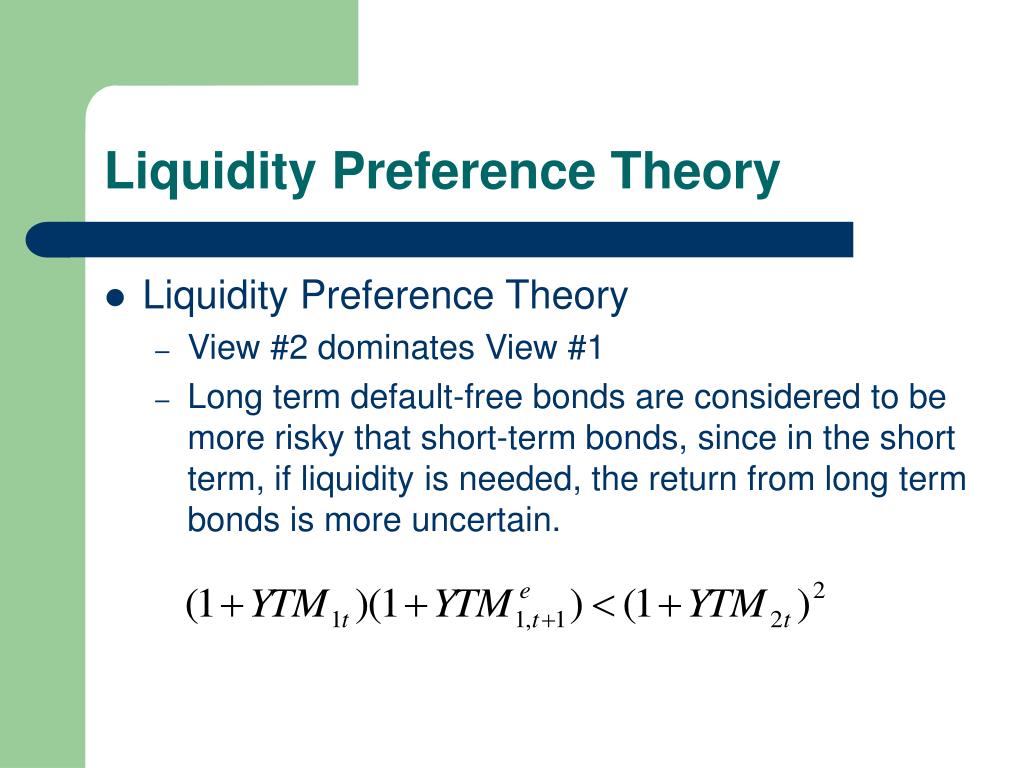
Understanding the Theory of Liquidity Preference: A Comprehensive Guide
The theory of liquidity preference, a cornerstone of Keynesian economics, provides a framework for understanding how interest rates are determined by the supply and demand for money. It posits that individuals and businesses prefer to hold their wealth in the most liquid form – money – and this preference influences the equilibrium interest rate in the market. This article delves into the intricacies of the theory of liquidity preference, exploring its key concepts, underlying assumptions, and practical implications.
What is Liquidity Preference?
At its core, liquidity preference refers to the demand for money as the most liquid asset. John Maynard Keynes, in his seminal work “The General Theory of Employment, Interest and Money,” argued that interest rates are not solely determined by saving and investment, as classical economists believed. Instead, the demand for money plays a crucial role. People hold money for various reasons, and these motives shape their liquidity preference.
Motives for Holding Money
Keynes identified three primary motives for holding money:
- Transaction Motive: This is the most basic motive. Individuals and businesses need money to conduct day-to-day transactions. The amount of money held for this purpose is directly related to income levels. Higher income typically leads to a greater need for transactional cash.
- Precautionary Motive: People hold money as a buffer against unforeseen circumstances or unexpected expenses. This acts as a safety net. The level of precautionary demand is influenced by factors such as risk aversion and economic uncertainty.
- Speculative Motive: This is the most interesting and arguably the most crucial motive in the context of the theory of liquidity preference. It arises from the belief that interest rates and asset prices are subject to change. Individuals may choose to hold money rather than invest in bonds or other assets if they expect interest rates to rise (and bond prices to fall). This is because higher interest rates make holding bonds less attractive compared to the flexibility of holding cash.
The Demand for Money
The total demand for money is the sum of the demands arising from these three motives. Mathematically, it can be represented as:
Md = Mt + Mp + Ms
Where:
- Md = Total demand for money
- Mt = Transaction demand
- Mp = Precautionary demand
- Ms = Speculative demand
The theory of liquidity preference emphasizes the inverse relationship between the speculative demand for money and the interest rate. As interest rates rise, the opportunity cost of holding money increases, making bonds and other interest-bearing assets more attractive. Consequently, the speculative demand for money falls. Conversely, when interest rates fall, the speculative demand for money rises as holding cash becomes relatively more appealing.
The Supply of Money
The supply of money is determined by the central bank, such as the Federal Reserve in the United States. The central bank controls the money supply through various tools, including open market operations, reserve requirements, and the discount rate. For the purpose of the theory of liquidity preference, the money supply is typically assumed to be fixed in the short run.
Equilibrium Interest Rate
The equilibrium interest rate is determined by the intersection of the money demand and money supply curves. When the money supply exceeds the money demand, there is an excess supply of money. Individuals and businesses will try to get rid of this excess money by buying bonds or other assets, which drives up bond prices and lowers interest rates. Conversely, when the money demand exceeds the money supply, there is an excess demand for money. People will try to obtain more money by selling bonds or other assets, which drives down bond prices and raises interest rates.
The equilibrium interest rate is the rate at which the quantity of money demanded equals the quantity of money supplied. This equilibrium rate reflects the collective preferences of individuals and businesses for holding money versus investing in other assets.
Factors Affecting the Equilibrium Interest Rate
Several factors can shift the money demand and money supply curves, thereby affecting the equilibrium interest rate. These include:
- Changes in Income: An increase in income typically leads to an increase in the transaction demand for money, shifting the money demand curve to the right and raising the equilibrium interest rate.
- Changes in Price Levels: Higher price levels increase the demand for money needed for transactions, shifting the money demand curve to the right and increasing the equilibrium interest rate.
- Changes in Expectations: Expectations about future interest rates and inflation can significantly influence the speculative demand for money. If people expect interest rates to rise, they may increase their demand for money, shifting the money demand curve to the right and raising the equilibrium interest rate.
- Central Bank Policy: The central bank’s monetary policy decisions directly impact the money supply. An increase in the money supply shifts the money supply curve to the right, lowering the equilibrium interest rate. Conversely, a decrease in the money supply shifts the money supply curve to the left, raising the equilibrium interest rate.
Implications of the Theory of Liquidity Preference
The theory of liquidity preference has significant implications for understanding macroeconomic phenomena and informing policy decisions. Some key implications include:
- Monetary Policy Effectiveness: The theory suggests that monetary policy can be effective in influencing interest rates and, consequently, aggregate demand and economic activity. By adjusting the money supply, the central bank can influence interest rates and stimulate or restrain economic growth.
- The Liquidity Trap: In situations where interest rates are already very low (near zero), the speculative demand for money may become infinitely elastic. This is known as a liquidity trap. In this scenario, further increases in the money supply may not lead to lower interest rates, as people simply hoard the additional money. This can render monetary policy ineffective.
- Understanding Financial Crises: The theory of liquidity preference provides insights into the dynamics of financial crises. During periods of uncertainty and fear, people tend to increase their demand for liquidity, leading to a sharp rise in the demand for money. This can drive up interest rates and exacerbate financial instability.
Criticisms and Limitations
While the theory of liquidity preference is a valuable framework, it is not without its criticisms and limitations:
- Simplifying Assumptions: The theory relies on simplifying assumptions, such as a fixed money supply and a focus on short-run dynamics. These assumptions may not always hold in the real world.
- Ignoring Credit Markets: The theory primarily focuses on the demand for money and the supply of money, neglecting the role of credit markets and the availability of credit in determining interest rates.
- Difficulty in Measuring Liquidity Preference: Quantifying the various motives for holding money and accurately measuring liquidity preference can be challenging in practice.
The Theory of Liquidity Preference Today
Despite its limitations, the theory of liquidity preference remains a relevant and influential concept in modern macroeconomics. It provides a valuable framework for understanding the relationship between money, interest rates, and economic activity. Central banks around the world continue to consider the principles of liquidity preference when formulating monetary policy decisions. Understanding the nuances of this theory is essential for anyone seeking to grasp the complexities of modern financial markets and macroeconomic policy. The demand for liquidity shapes financial markets and influences investment decisions.
The theory of liquidity preference also helps explain why investors often demand a premium for holding less liquid assets. This premium, known as the liquidity premium, reflects the additional return investors require to compensate them for the risk and inconvenience of holding assets that are not easily converted into cash. [See also: Understanding Interest Rate Risk]
Furthermore, the theory of liquidity preference can be applied to understand the behavior of financial institutions. Banks, for example, must manage their liquidity carefully to meet the demands of their depositors and borrowers. They hold reserves of cash and other liquid assets to ensure they can meet their obligations and avoid a liquidity crisis. The availability of liquid assets is crucial for the stability of the financial system.
In conclusion, the theory of liquidity preference offers a compelling explanation of how interest rates are determined by the supply and demand for money. While it has its limitations, it remains a valuable tool for understanding macroeconomic phenomena and informing policy decisions. By considering the motives for holding money and the factors that influence liquidity preference, economists and policymakers can gain a deeper understanding of the forces that shape financial markets and the overall economy. This understanding is essential for promoting economic stability and sustainable growth. The theory of liquidity preference shows how the desire for cash impacts the economy.
