Decoding the A B C Pattern: Understanding its Significance and Applications
The A B C pattern is a fundamental concept across various disciplines, from financial markets to behavioral psychology. Understanding the A B C pattern can provide valuable insights and predictive capabilities. This article delves into the intricacies of the A B C pattern, exploring its definition, applications, and significance in different fields. We’ll examine how to identify and interpret this pattern, providing you with a comprehensive understanding of its potential. The A B C pattern is not just a theoretical concept; it’s a practical tool that can be applied in real-world scenarios to make informed decisions.
What is the A B C Pattern?
At its core, the A B C pattern represents a sequence of three distinct events or points, labeled A, B, and C. The relationship between these points defines the specific context of the pattern. For instance, in finance, the A B C pattern often refers to a corrective wave in a price trend. In behavioral psychology, it may describe the Antecedent, Behavior, and Consequence model. The key is recognizing the sequential and interconnected nature of A, B, and C.
The A B C pattern isn’t limited to just three points; it can also represent a more complex sequence with variations and extensions. However, the fundamental principle remains the same: a defined sequence of events with a discernible relationship. It is widely used in technical analysis to try and predict future market movements. Recognizing the A B C pattern allows for better decision making when making trades.
The A B C Pattern in Financial Markets
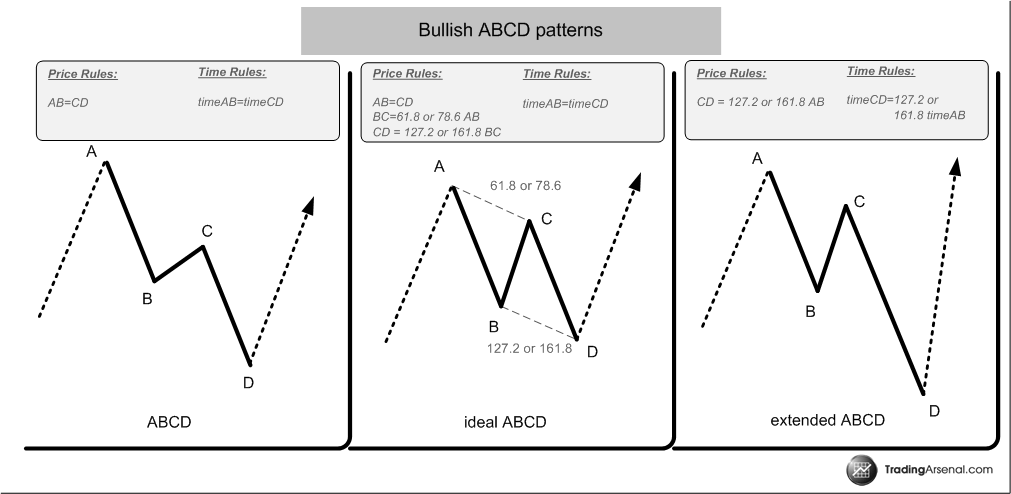
In financial markets, the A B C pattern is commonly associated with Elliott Wave Theory, which posits that market prices move in specific patterns. The A B C pattern represents a corrective wave, typically moving against the prevailing trend. Wave A represents the initial correction, Wave B a temporary retracement, and Wave C the final move to complete the correction. Identifying this pattern can help traders anticipate potential trend reversals or continuations. Understanding the magnitude and timing of these waves is crucial for effective trading strategies. [See also: Stock Market Analysis Techniques]
For example, if a stock price has been trending upward, an A B C pattern might signal a temporary pullback before the upward trend resumes. Conversely, if the A B C pattern breaks below a key support level, it could indicate a more significant trend reversal. Traders use various technical indicators, such as Fibonacci retracements, to project potential price targets based on the A B C pattern.
Identifying the A B C Pattern in Stocks
Identifying the A B C pattern in stock charts requires careful observation and analysis. Look for a clear sequence of three distinct price movements. Wave A should be a noticeable correction against the prevailing trend. Wave B should retrace a portion of Wave A, and Wave C should complete the correction. Volume and momentum indicators can provide additional confirmation.
It’s important to note that the A B C pattern isn’t always perfect. Market noise and volatility can sometimes obscure the pattern, making it challenging to identify. Therefore, it’s essential to use other technical analysis tools and indicators in conjunction with the A B C pattern to increase the probability of a correct assessment. The A B C pattern can be useful in forex trading as well.
The A B C Pattern in Behavioral Psychology
In behavioral psychology, the A B C pattern refers to the Antecedent, Behavior, and Consequence model. This model is a fundamental tool for understanding and modifying behavior. The Antecedent is the event or situation that precedes the behavior. The Behavior is the action or response exhibited by the individual. The Consequence is the outcome or result of the behavior.
By analyzing the A B C pattern, psychologists can identify the triggers for specific behaviors and the consequences that reinforce or discourage those behaviors. This information can then be used to develop interventions aimed at changing unwanted behaviors or promoting desired ones. Understanding the connection between antecedent, behavior, and consequence is key to effective behavioral modification. The A B C pattern can be a great tool for parents trying to understand their children’s actions.
Applying the A B C Pattern to Behavior Modification
To apply the A B C pattern to behavior modification, start by identifying the specific behavior you want to change. Then, carefully observe the events that precede the behavior (the Antecedents) and the consequences that follow it. Look for patterns and relationships that might be contributing to the behavior.
For example, if you want to reduce a child’s tantrums, you might observe that the tantrums typically occur when the child is denied something they want (the Antecedent). The consequence might be that the parent eventually gives in to the child’s demands to stop the tantrum. By understanding this A B C pattern, the parent can implement strategies to prevent the tantrums from occurring in the first place, such as setting clear expectations and providing alternative solutions.
The A B C Pattern in Project Management
The A B C pattern can also be applied to project management, although not as formally as in finance or psychology. In this context, A, B, and C can represent different stages or phases of a project. For example, A might represent the planning phase, B the execution phase, and C the completion phase. Analyzing the relationships and dependencies between these phases can help project managers identify potential bottlenecks and improve project outcomes. The A B C pattern allows project managers to visualize the project life cycle.
Another application of the A B C pattern in project management is risk assessment. A might represent a potential risk, B the trigger event that causes the risk to materialize, and C the impact of the risk on the project. By identifying and analyzing these A B C patterns, project managers can develop mitigation strategies to minimize the negative impact of potential risks. Proactive measures are key when using the A B C pattern in project management.
Limitations of the A B C Pattern
While the A B C pattern can be a valuable tool, it’s important to acknowledge its limitations. The pattern is not always clear or predictable, especially in complex or volatile environments. External factors and unforeseen events can disrupt the pattern and make it difficult to interpret accurately.
Furthermore, the interpretation of the A B C pattern can be subjective and may vary depending on the individual’s perspective and experience. Therefore, it’s essential to use the pattern in conjunction with other analytical tools and techniques to increase the reliability of your conclusions. Relying solely on the A B C pattern without considering other factors can lead to inaccurate predictions or flawed decisions.
Conclusion: Mastering the A B C Pattern
The A B C pattern is a versatile concept with applications across various fields. Whether you’re analyzing financial markets, understanding human behavior, or managing projects, the ability to recognize and interpret the A B C pattern can provide valuable insights and improve your decision-making skills. By understanding the fundamental principles of the pattern and its limitations, you can effectively leverage its power to achieve your goals. The A B C pattern is a powerful tool for anyone looking to improve their understanding of the world around them. It is important to remember that the A B C pattern is just one of many tools that can be used to analyze data and make predictions. It should not be used in isolation, but rather in conjunction with other methods.
