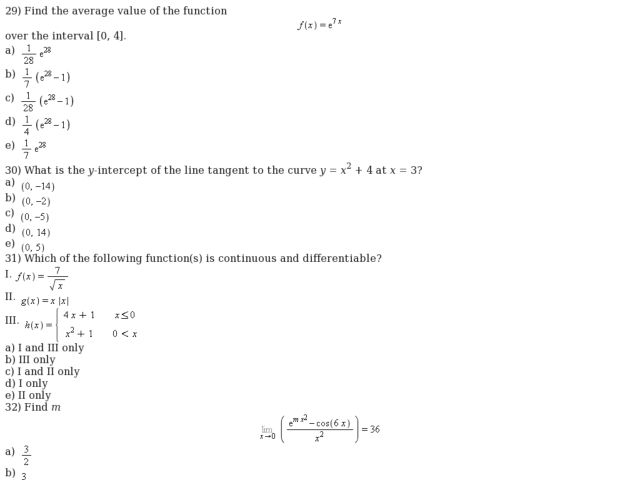
Decoding the 2019 AP Calculus BC Multiple Choice: A Comprehensive Guide
The Advanced Placement (AP) Calculus BC exam is a crucial stepping stone for students aspiring to pursue careers in STEM fields. Among its sections, the multiple-choice portion often presents a significant challenge, requiring not only a deep understanding of calculus concepts but also efficient problem-solving skills. This article provides a comprehensive analysis of the 2019 AP Calculus BC multiple choice exam, offering insights into the types of questions asked, the key concepts tested, and effective strategies for tackling this section. Whether you are a student preparing for the exam or an educator guiding your students, understanding the nuances of the 2019 AP Calculus BC multiple choice questions is paramount. The availability of the 2019 AP Calculus BC multiple choice PDF offers a valuable resource for practice and assessment.
Overview of the AP Calculus BC Exam
Before diving into the specifics of the 2019 AP Calculus BC multiple choice section, it’s important to understand the overall structure of the exam. The AP Calculus BC exam is designed to assess a student’s understanding of calculus concepts covered in a full-year college-level calculus course. The exam is divided into two main sections: multiple choice and free-response. Each section is worth 50% of the total exam score.
- Section I: Multiple Choice
- Part A: 30 questions, 60 minutes, no calculator allowed
- Part B: 15 questions, 45 minutes, calculator allowed
- Section II: Free Response
- 2 questions, 30 minutes, calculator required
- 4 questions, 60 minutes, no calculator allowed
The multiple-choice section tests a wide range of calculus topics, including limits, derivatives, integrals, series, and differential equations. The questions vary in difficulty, from straightforward applications of basic concepts to more challenging problems that require a deeper understanding and creative problem-solving skills. Accessing a 2019 AP Calculus BC multiple choice PDF allows students to familiarize themselves with the format and difficulty level.
Key Concepts Tested in the 2019 AP Calculus BC Multiple Choice
The 2019 AP Calculus BC multiple choice section, like other years, assessed a broad spectrum of calculus concepts. Here are some of the key areas that were heavily tested:
Limits and Continuity
Questions on limits and continuity often involve evaluating limits using algebraic techniques, L’Hôpital’s Rule, and graphical analysis. Students should be comfortable with the concept of continuity and its implications, such as the Intermediate Value Theorem and the Extreme Value Theorem.
Derivatives
Derivatives are a cornerstone of calculus, and the multiple-choice section typically includes numerous questions on this topic. These questions may involve finding derivatives of various functions (polynomial, trigonometric, exponential, logarithmic, and inverse trigonometric), applying the chain rule, implicit differentiation, and related rates problems. Understanding the relationship between a function and its derivative is crucial for solving optimization problems and analyzing the behavior of functions.
Integrals
Integration is another fundamental concept tested extensively in the AP Calculus BC exam. Multiple-choice questions on integrals may involve evaluating definite and indefinite integrals using various techniques, such as u-substitution, integration by parts, and trigonometric substitution. Students should also be familiar with applications of integrals, such as finding areas, volumes, and average values.
Series
The AP Calculus BC exam places a significant emphasis on series. Questions on series may involve determining the convergence or divergence of infinite series using various tests (e.g., the ratio test, the root test, the integral test, the comparison test, and the alternating series test). Students should also be familiar with power series, Taylor series, and Maclaurin series, and be able to find the interval of convergence and use series to approximate function values.
Differential Equations
Differential equations are another important topic covered in the AP Calculus BC exam. Multiple-choice questions on differential equations may involve solving separable differential equations, finding particular solutions given initial conditions, and interpreting slope fields. Students should also be familiar with applications of differential equations, such as modeling population growth and decay.
Strategies for Tackling the 2019 AP Calculus BC Multiple Choice
Success on the 2019 AP Calculus BC multiple choice section requires not only a strong understanding of calculus concepts but also effective test-taking strategies. Here are some tips to help you maximize your score:
Understand the Question Types
Familiarize yourself with the types of questions that are typically asked on the multiple-choice section. This will help you anticipate the concepts being tested and choose the most appropriate problem-solving strategies. Reviewing the 2019 AP Calculus BC multiple choice PDF is invaluable for this purpose.
Manage Your Time Wisely
Time management is crucial on the multiple-choice section. Since you have a limited amount of time to answer each question, it’s important to pace yourself and avoid spending too much time on any one question. If you get stuck on a question, move on and come back to it later if you have time.
Use Your Calculator Effectively
The calculator-allowed portion of the multiple-choice section provides an opportunity to use your calculator to solve problems more quickly and accurately. However, it’s important to use your calculator strategically and avoid relying on it for every calculation. Be sure to practice using your calculator to perform common calculus operations, such as finding derivatives, integrals, and roots of equations.
Eliminate Incorrect Answer Choices
Even if you’re not sure of the correct answer, you can often improve your chances of getting the question right by eliminating incorrect answer choices. Look for answer choices that are obviously wrong or that contradict known facts or principles. By eliminating incorrect answer choices, you can narrow down the possibilities and increase your chances of selecting the correct answer.
Practice, Practice, Practice
The best way to prepare for the 2019 AP Calculus BC multiple choice section is to practice as many questions as possible. Work through past exams, sample questions, and practice problems from textbooks and online resources. Pay attention to your mistakes and learn from them. By practicing regularly, you’ll build your confidence and improve your problem-solving skills. The 2019 AP Calculus BC multiple choice PDF provides an excellent resource for targeted practice.
Analyzing the 2019 AP Calculus BC Multiple Choice PDF
The 2019 AP Calculus BC multiple choice PDF offers a valuable resource for students and educators alike. By analyzing the questions in this PDF, you can gain insights into the types of concepts that were tested, the level of difficulty of the questions, and the common mistakes that students make. This information can be used to tailor your preparation and instruction to address the specific areas where students struggle.
When reviewing the 2019 AP Calculus BC multiple choice PDF, pay attention to the following:
- The topics covered: Identify the key calculus concepts that are tested in the multiple-choice questions.
- The difficulty level: Assess the difficulty of the questions and identify the types of problems that students find most challenging.
- The common mistakes: Analyze the incorrect answer choices and identify the common mistakes that students make.
- The problem-solving strategies: Identify the most effective strategies for solving the multiple-choice questions.
By carefully analyzing the 2019 AP Calculus BC multiple choice PDF, you can gain a deeper understanding of the exam and improve your chances of success.
Resources for AP Calculus BC Preparation
In addition to the 2019 AP Calculus BC multiple choice PDF, there are many other resources available to help you prepare for the AP Calculus BC exam. These resources include:
- Textbooks: Use a comprehensive calculus textbook to review the concepts and practice problems.
- Review books: Use an AP Calculus BC review book to get a concise overview of the key topics and practice questions.
- Online resources: Utilize online resources, such as Khan Academy, College Board, and AP Central, to access videos, practice problems, and other helpful materials.
- Tutoring: Consider working with a tutor who can provide personalized instruction and guidance.
By utilizing a variety of resources and practicing regularly, you can build your confidence and improve your performance on the AP Calculus BC exam. Remember to focus on understanding the underlying concepts and developing effective problem-solving strategies. Accessing and thoroughly reviewing the 2019 AP Calculus BC multiple choice questions through the provided PDF is a critical step in your preparation.
Conclusion
The 2019 AP Calculus BC multiple choice section is a challenging but manageable part of the exam. By understanding the key concepts tested, developing effective problem-solving strategies, and practicing regularly with resources like the 2019 AP Calculus BC multiple choice PDF, you can increase your chances of success. Remember to manage your time wisely, use your calculator effectively, and eliminate incorrect answer choices. With diligent preparation and a strategic approach, you can confidently tackle the multiple-choice section and achieve a high score on the AP Calculus BC exam. Good luck!
[See also: AP Calculus BC Exam Tips and Tricks]
[See also: Understanding Calculus Concepts for AP Success]
