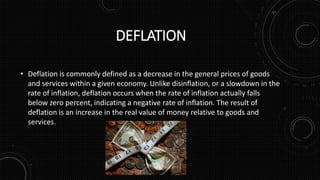
Define Deflation: Understanding Its Causes, Consequences, and Potential Solutions
Deflation, in its simplest form, is the opposite of inflation. While inflation signifies a general increase in the price level of goods and services in an economy over a period of time, define deflation as a sustained decrease in that same general price level. This means that the purchasing power of money increases; you can buy more goods and services with the same amount of money. Although it might seem beneficial at first glance, deflation can have detrimental effects on an economy, potentially leading to decreased production, lower wages, and increased debt burdens.
What is Deflation? A Deeper Dive
To define deflation more precisely, it’s crucial to understand that it’s not simply a temporary dip in prices. It’s a persistent decline, often lasting for several months or even years. This distinguishes it from disinflation, which is a slowdown in the rate of inflation. During disinflation, prices are still rising, but at a slower pace. In contrast, during deflation, prices are actually falling.
The measurement of deflation typically involves tracking changes in the Consumer Price Index (CPI) or the GDP deflator. The CPI measures the average change over time in the prices paid by urban consumers for a basket of consumer goods and services. The GDP deflator, on the other hand, measures the change in prices for all goods and services produced in an economy.
The Causes of Deflation
Several factors can contribute to deflation. Understanding these causes is essential for policymakers seeking to address deflationary pressures:
- Decreased Aggregate Demand: A decline in overall demand for goods and services can lead to deflation. This can be caused by factors such as a recession, increased savings rates, or decreased government spending. When demand falls, businesses may lower prices to attract customers, leading to a general decline in the price level.
- Increased Aggregate Supply: Conversely, a significant increase in the supply of goods and services without a corresponding increase in demand can also lead to deflation. This could result from technological advancements that boost production efficiency or a sudden influx of imported goods.
- Debt: High levels of debt, whether held by individuals, businesses, or governments, can exacerbate deflationary pressures. As debt burdens increase, individuals and businesses may cut back on spending to repay their debts, further reducing demand.
- Expectations of Future Price Declines: If consumers and businesses expect prices to continue falling in the future, they may delay purchases and investments, hoping to buy goods and services at even lower prices later. This can create a self-fulfilling prophecy, as decreased spending further weakens demand and pushes prices down.
- Contraction of the Money Supply: A decrease in the amount of money circulating in the economy can also contribute to deflation. This can occur if the central bank tightens monetary policy by raising interest rates or reducing the money supply. Reduced money supply impacts liquidity which in turn impacts demand and consumption, leading to define deflation.
The Consequences of Deflation
While falling prices might seem appealing to consumers, deflation can have significant negative consequences for the economy:
- Decreased Production and Economic Growth: As prices fall, businesses may experience lower profits or even losses. This can lead them to reduce production, lay off workers, and postpone investments, all of which contribute to slower economic growth or even a recession.
- Increased Debt Burdens: Deflation increases the real value of debt. This means that borrowers have to repay their debts with money that is worth more than the money they borrowed. This can be particularly problematic for individuals and businesses with large amounts of debt, potentially leading to defaults and bankruptcies.
- Wage Cuts and Unemployment: As businesses struggle to maintain profitability in a deflationary environment, they may be forced to cut wages or lay off workers. This can lead to lower incomes, increased unemployment, and decreased consumer spending.
- Postponed Consumption and Investment: As mentioned earlier, expectations of future price declines can lead consumers and businesses to delay purchases and investments, further weakening demand and exacerbating deflationary pressures.
- Increased Real Interest Rates: Deflation increases the real interest rate, which is the nominal interest rate minus the inflation rate. Higher real interest rates can discourage borrowing and investment, further slowing down economic growth.
Historical Examples of Deflation
Deflation has occurred in various countries throughout history. One notable example is the Great Depression of the 1930s, during which the United States experienced a prolonged period of deflation. Prices fell sharply, unemployment soared, and the economy contracted significantly.
Japan also experienced a period of deflation in the late 1990s and early 2000s, often referred to as the “Lost Decade.” This period was characterized by falling prices, stagnant economic growth, and high levels of debt. The Japanese government implemented various measures to combat deflation, but with limited success.
Combating Deflation: Policy Options
Policymakers have several tools at their disposal to combat deflation:
- Monetary Policy: Central banks can use monetary policy to stimulate demand and increase the money supply. This can involve lowering interest rates, purchasing government bonds (quantitative easing), or implementing negative interest rates. The goal is to encourage borrowing and spending, thereby boosting demand and pushing prices up.
- Fiscal Policy: Governments can use fiscal policy to increase aggregate demand through increased government spending or tax cuts. Increased government spending can directly boost demand, while tax cuts can increase disposable income and encourage consumer spending.
- Direct Intervention: In some cases, governments may intervene directly in the economy to support prices or stimulate demand. This could involve setting price floors, providing subsidies to businesses, or implementing public works projects.
- Managing Expectations: Central banks can also try to manage expectations by communicating their commitment to achieving a target inflation rate. By convincing consumers and businesses that prices will rise in the future, they can encourage them to spend and invest today, thereby helping to combat deflation.
Deflation vs. Disinflation: Key Differences
It’s important to distinguish between deflation and disinflation. As mentioned earlier, disinflation is a slowdown in the rate of inflation, while deflation is an actual decline in the price level. During disinflation, prices are still rising, but at a slower pace. During deflation, prices are falling. Disinflation is often seen as a less serious problem than deflation, as it does not necessarily lead to the same negative consequences.
Is Deflation Always Bad?
While deflation is generally considered to be harmful to the economy, there are some theoretical scenarios in which it could be beneficial. For example, if deflation is caused by a significant increase in productivity, prices could fall without necessarily leading to decreased production or unemployment. However, such scenarios are rare, and deflation is generally viewed as a sign of economic weakness.
The Role of Central Banks in Managing Deflation
Central banks play a crucial role in managing deflation. They are responsible for monitoring price levels and implementing policies to maintain price stability. In the face of deflationary pressures, central banks must act decisively to stimulate demand and prevent a prolonged period of falling prices. This often involves a combination of monetary and fiscal policies.
Conclusion: Understanding the Threat of Deflation
Define deflation as a persistent decline in the general price level, can have serious consequences for the economy. It can lead to decreased production, lower wages, increased debt burdens, and postponed consumption and investment. While falling prices might seem appealing in the short term, the long-term effects of deflation can be detrimental to economic growth and stability. Policymakers must be vigilant in monitoring price levels and implementing appropriate measures to combat deflationary pressures. Understanding the causes and consequences of define deflation is essential for ensuring a healthy and stable economy. Successfully define deflation allows for better policy response. Addressing define deflation early is crucial. The impact of define deflation can be widespread. Factors that define deflation are important to understand. Recognizing define deflation is the first step. Furthermore, define deflation in the context of global economy is critical. Strategies to combat define deflation need to be carefully considered. Preventative measures against define deflation are also valuable. The challenge with define deflation is its self-reinforcing nature. The key is to define deflation and act quickly to prevent it from taking hold. Finally, it’s vital to define deflation accurately to formulate effective solutions. Therefore, knowing how to define deflation is paramount for economic stability. The implications of define deflation are far-reaching and complex. Considering how to define deflation is crucial for long-term planning. The significance of define deflation cannot be overstated.
[See also: What is Inflation?]
[See also: Understanding Monetary Policy]
[See also: Fiscal Policy Explained]
