Grid Trading: A Comprehensive Guide to Automated Trading Strategies
In the fast-paced world of financial markets, traders are constantly seeking innovative strategies to capitalize on price fluctuations and generate consistent profits. One such strategy that has gained considerable traction is grid trading. This automated trading approach involves setting up a grid of buy and sell orders at predetermined price intervals, aiming to profit from small price movements within a defined range. This comprehensive guide will delve into the intricacies of grid trading, exploring its mechanics, advantages, disadvantages, and practical applications. Understanding grid trading is crucial for anyone looking to automate their trading and potentially generate consistent income. The core principle revolves around systematically placing orders around a pre-defined price level, leveraging volatility to your advantage. Let’s explore how this strategy works in detail.
Understanding the Mechanics of Grid Trading
At its core, grid trading is a range-bound strategy, meaning it thrives in markets that exhibit sideways or oscillating price action. The strategy involves setting up a grid of buy orders below the current market price and a grid of sell orders above it. Each order is placed at a predetermined interval, creating a ‘grid’ of potential entry and exit points. When the price moves down, buy orders are triggered, and when the price moves up, sell orders are triggered. The goal is to profit from the small price differences between these orders.
Setting Up a Grid
The process of setting up a grid trading system involves several key decisions:
- Defining the Price Range: Determine the upper and lower boundaries of the grid based on historical price data, volatility indicators, and personal risk tolerance.
- Establishing Grid Spacing: Choose the price interval between each order. Smaller intervals capture more frequent price movements but also increase the number of trades and associated transaction costs. Larger intervals reduce the frequency of trades but may miss out on smaller profit opportunities.
- Determining Order Size: Decide on the size of each buy and sell order. This should be based on your risk management strategy and account balance.
- Setting Take-Profit and Stop-Loss Levels: While grid trading often relies on small, frequent profits, it’s important to set take-profit and stop-loss levels to limit potential losses in case of adverse price movements.
How Grid Trading Works in Practice
Imagine a scenario where a trader believes a particular stock will trade between $50 and $60. They set up a grid trading system with buy orders placed every $1 below the current price of $55 and sell orders placed every $1 above it. If the price drops to $54, the first buy order is triggered. When the price subsequently rises to $55, the corresponding sell order is triggered, locking in a $1 profit. This process repeats as the price fluctuates within the grid range. Grid trading systems can be automated through trading bots or platforms with built-in grid trading functionalities.
Advantages of Grid Trading
Grid trading offers several advantages that make it an attractive strategy for certain traders:
- Automation: The automated nature of grid trading allows traders to execute strategies without constant monitoring, freeing up time for other activities.
- Profitability in Ranging Markets: Grid trading excels in markets that lack a clear trend, generating profits from small price fluctuations.
- Flexibility: Traders can customize the grid parameters to suit their risk tolerance and trading style.
- Potential for Consistent Income: When implemented effectively, grid trading can provide a steady stream of income.
Disadvantages and Risks of Grid Trading
Despite its advantages, grid trading also carries certain risks and disadvantages that traders should be aware of:
- Risk of Large Losses in Trending Markets: If the price breaks out of the grid range and moves in a strong trend, the system can accumulate significant losses as buy orders are triggered without corresponding sell orders (or vice versa).
- Capital Intensive: Grid trading requires a substantial amount of capital to fund the multiple open positions within the grid.
- Transaction Costs: Frequent trading can lead to high transaction costs, which can erode profits.
- Potential for Margin Calls: In leveraged trading, a significant price move against the grid can trigger margin calls, forcing traders to deposit additional funds to maintain their positions.
Mitigating the Risks of Grid Trading
While grid trading involves inherent risks, several strategies can be employed to mitigate these risks:
- Use Stop-Loss Orders: Implementing stop-loss orders for the entire grid can limit potential losses in case of a strong trend.
- Adjust Grid Parameters Dynamically: Adapting the grid spacing and order size based on market volatility can help to optimize performance.
- Trade in Less Volatile Markets: Choosing markets with lower volatility can reduce the risk of price breakouts.
- Diversify Your Portfolio: Avoid allocating all your capital to grid trading. Diversifying your portfolio across different strategies and asset classes can reduce overall risk.
- Monitor Market Conditions: While grid trading is automated, it’s important to monitor market conditions regularly and adjust the grid parameters as needed.
Grid Trading Strategies and Variations
Several variations and strategies can be incorporated into a grid trading system to enhance its performance:
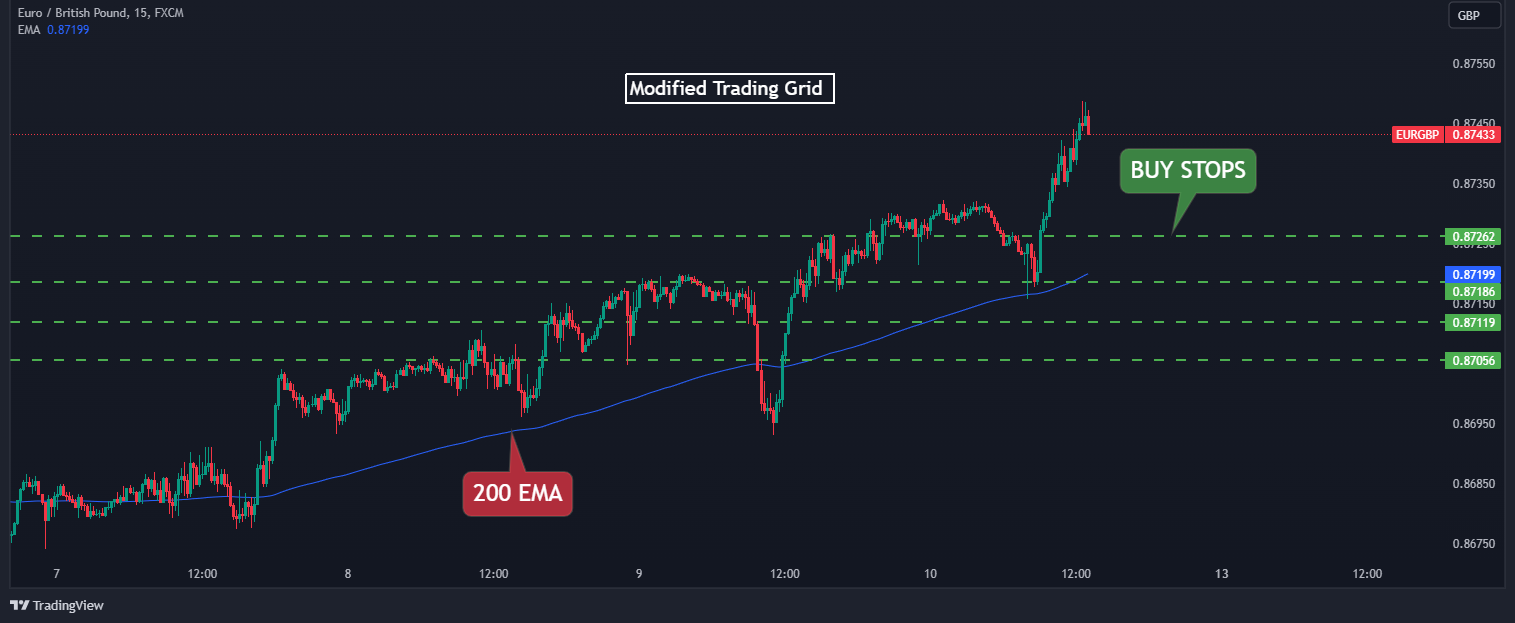
- Trend-Following Grid: This strategy combines grid trading with trend-following indicators. The grid is set up in the direction of the prevailing trend, aiming to profit from both the trend and the small price fluctuations within the grid.
- Martingale Grid: This strategy involves increasing the order size after each losing trade, aiming to recover losses with a single profitable trade. However, this strategy is highly risky and can lead to significant losses if the trend continues against the grid.
- Adaptive Grid: This strategy dynamically adjusts the grid spacing and order size based on market volatility and other factors. This requires sophisticated algorithms and real-time data analysis.
Choosing the Right Assets for Grid Trading
The choice of assets for grid trading is crucial for its success. Ideally, assets should exhibit the following characteristics:
- Range-Bound Behavior: The asset should trade within a defined range for extended periods.
- Sufficient Liquidity: The asset should have sufficient liquidity to ensure that orders are filled quickly and efficiently.
- Low Volatility: While some volatility is necessary for generating profits, excessive volatility can increase the risk of price breakouts.
Common assets used for grid trading include:
- Forex Currency Pairs: Many currency pairs tend to trade within defined ranges, making them suitable for grid trading.
- Cryptocurrencies: Certain cryptocurrencies can exhibit range-bound behavior, although volatility can be higher.
- Stocks: Some stocks with stable earnings and low volatility can be suitable for grid trading.
- Commodities: Certain commodities, such as precious metals, can also be traded using grid trading strategies.
Tools and Platforms for Grid Trading
Several trading platforms and tools offer built-in grid trading functionalities or allow for the creation of custom grid trading bots:
- MetaTrader 4/5 (MT4/5): Popular trading platforms with a wide range of automated trading tools and expert advisors (EAs) that can be used for grid trading.
- cTrader: Another popular platform with advanced charting tools and automated trading capabilities.
- TradingView: A web-based charting platform that allows users to create custom trading strategies and backtest them.
- Cryptocurrency Trading Bots: Several platforms offer dedicated cryptocurrency trading bots with built-in grid trading functionalities.
Backtesting and Optimization
Before deploying a grid trading strategy with real capital, it’s crucial to backtest it using historical data. Backtesting allows you to evaluate the strategy’s performance under different market conditions and identify potential weaknesses. Optimization involves adjusting the grid parameters to improve the strategy’s profitability and reduce its risk. [See also: Backtesting Trading Strategies]
The Future of Grid Trading
Grid trading continues to evolve with advancements in technology and the increasing availability of trading tools and platforms. The rise of artificial intelligence (AI) and machine learning (ML) is likely to play a significant role in the future of grid trading, enabling more sophisticated and adaptive strategies. AI-powered grid trading systems can analyze vast amounts of data in real-time, predict market movements, and adjust grid parameters dynamically to optimize performance. As markets become more complex and volatile, grid trading is likely to remain a popular and effective strategy for traders seeking to generate consistent profits in range-bound conditions.
Conclusion
Grid trading is a powerful automated trading strategy that can be highly profitable in ranging markets. However, it also carries significant risks, particularly in trending markets. By understanding the mechanics of grid trading, mitigating its risks, and choosing the right assets and tools, traders can effectively implement this strategy and potentially generate a consistent stream of income. Remember to always backtest your strategies and adjust them based on market conditions. [See also: Algorithmic Trading: An Overview]
