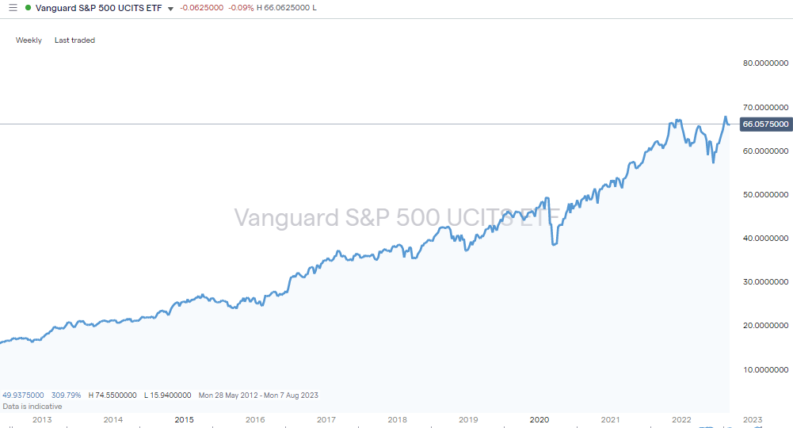
Investing in the Vanguard S&P 500 ETF: A Comprehensive Guide
The Vanguard S&P 500 ETF (VOO) is a popular investment vehicle that allows investors to gain broad exposure to the U.S. stock market. This Exchange Traded Fund (ETF) tracks the performance of the Standard & Poor’s 500 index, which comprises 500 of the largest publicly traded companies in the United States. Investing in the Vanguard S&P 500 ETF is often seen as a core holding in many diversified investment portfolios, offering diversification, low costs, and potential for long-term growth. This guide will provide a comprehensive overview of the Vanguard S&P 500 ETF, covering its features, benefits, risks, and how to incorporate it into your investment strategy.
Understanding the S&P 500 Index
The S&P 500 index is a market-capitalization-weighted index, meaning that companies with larger market capitalizations have a greater influence on the index’s performance. The index represents approximately 80% of the total U.S. equity market capitalization, making it a widely recognized benchmark for the overall health of the U.S. stock market. Sectors within the S&P 500 include technology, healthcare, financials, consumer discretionary, and industrials, among others. The Vanguard S&P 500 ETF mirrors the composition and weighting of this index.
Key Features of the Vanguard S&P 500 ETF (VOO)
- Low Expense Ratio: One of the most attractive features of the VOO is its low expense ratio. As of [Insert Current Date], the expense ratio is just 0.03%, making it one of the most cost-effective ways to invest in the S&P 500. This low cost can significantly enhance long-term returns.
- Broad Diversification: By tracking the S&P 500, the VOO provides instant diversification across 500 of the largest U.S. companies. This diversification helps to mitigate risk compared to investing in individual stocks.
- Liquidity: As an ETF, VOO is highly liquid, meaning it can be easily bought and sold on major stock exchanges. This liquidity allows investors to quickly adjust their positions as needed.
- Transparency: The holdings of the Vanguard S&P 500 ETF are publicly disclosed, providing investors with transparency into the underlying assets.
Benefits of Investing in the Vanguard S&P 500 ETF
Diversification and Risk Mitigation
Investing in the Vanguard S&P 500 ETF offers instant diversification, spreading your investment across a broad range of companies and sectors. This diversification helps to reduce the impact of any single company’s performance on your overall portfolio. By holding a basket of 500 stocks, the ETF mitigates the risk associated with investing in individual stocks, providing a more stable investment option.
Low Cost and Efficiency
The low expense ratio of the Vanguard S&P 500 ETF makes it an efficient way to access the U.S. stock market. Lower costs translate to higher returns over the long term, as more of your investment dollars are working for you rather than being eaten up by fees. The ETF’s structure also allows for tax efficiency, as it typically has lower capital gains distributions compared to actively managed mutual funds. [See also: Tax-Advantaged Investing Strategies]
Long-Term Growth Potential
Historically, the S&P 500 has delivered strong long-term returns. While past performance is not indicative of future results, investing in the Vanguard S&P 500 ETF provides exposure to the growth potential of the U.S. economy. The ETF’s composition reflects the dynamic nature of the U.S. market, as companies are added and removed from the index based on their market capitalization and other eligibility criteria.
Ease of Investment
The Vanguard S&P 500 ETF is easily accessible through most brokerage accounts. Investors can buy and sell shares of the ETF just like they would with individual stocks. This ease of investment makes it a convenient option for both novice and experienced investors.
Risks Associated with Investing in the Vanguard S&P 500 ETF
Market Risk
The Vanguard S&P 500 ETF is subject to market risk, which is the risk that the overall stock market will decline. Economic downturns, geopolitical events, and other factors can negatively impact the performance of the S&P 500 and, consequently, the ETF. Investors should be prepared for potential market volatility and be aware that the value of their investment can fluctuate.
Concentration Risk
While the Vanguard S&P 500 ETF provides diversification, it is still concentrated in the U.S. stock market. Investors who allocate a significant portion of their portfolio to the ETF may be overexposed to the U.S. economy and could be vulnerable to events that specifically impact the U.S. market. Diversifying across different asset classes and geographic regions can help to mitigate this risk. [See also: International Stock ETFs]
Tracking Error
Although the Vanguard S&P 500 ETF aims to closely track the performance of the S&P 500 index, there may be slight deviations due to factors such as fund expenses and trading costs. This deviation is known as tracking error. While Vanguard strives to minimize tracking error, it is important for investors to be aware that the ETF’s performance may not exactly match the index’s performance.
Incorporating the Vanguard S&P 500 ETF into Your Investment Strategy
Core Holding in a Diversified Portfolio
The Vanguard S&P 500 ETF is often used as a core holding in a diversified investment portfolio. Its broad diversification, low cost, and long-term growth potential make it a suitable foundation for building a well-rounded portfolio. Investors can then add other asset classes, such as bonds, international stocks, and real estate, to further diversify their holdings and manage risk.
Dollar-Cost Averaging
Dollar-cost averaging is a strategy where investors invest a fixed amount of money at regular intervals, regardless of the ETF’s price. This strategy can help to reduce the impact of market volatility on your investment returns. By investing a consistent amount over time, you are buying more shares when the price is low and fewer shares when the price is high. This can lead to a lower average cost per share over the long term.
Rebalancing Your Portfolio
Rebalancing your portfolio involves periodically adjusting your asset allocation to maintain your desired risk level and investment objectives. As the Vanguard S&P 500 ETF’s value fluctuates, its weight in your portfolio may drift away from your target allocation. Rebalancing involves selling some of your holdings in the ETF and using the proceeds to buy other assets that are underweighted in your portfolio. This helps to ensure that your portfolio remains aligned with your investment goals. [See also: Portfolio Rebalancing Strategies]
Long-Term Investment Horizon
Investing in the Vanguard S&P 500 ETF is generally best suited for investors with a long-term investment horizon. The stock market can be volatile in the short term, and it may take time for the ETF to generate significant returns. However, over the long term, the S&P 500 has historically delivered strong performance. Investors who are willing to ride out market fluctuations and stay invested for the long haul are more likely to benefit from the ETF’s growth potential.
Alternatives to the Vanguard S&P 500 ETF
While the Vanguard S&P 500 ETF is a popular choice, there are other options available for investors seeking exposure to the S&P 500. These include:
- Other S&P 500 ETFs: Several other ETF providers offer S&P 500 ETFs, such as the SPDR S&P 500 ETF Trust (SPY) and the iShares Core S&P 500 ETF (IVV). These ETFs have similar characteristics to the VOO but may have slightly different expense ratios or trading volumes.
- S&P 500 Mutual Funds: Mutual funds that track the S&P 500 are also available. These funds may have higher expense ratios than ETFs but may offer additional services, such as automatic dividend reinvestment.
- Total Stock Market ETFs: ETFs that track the entire U.S. stock market, such as the Vanguard Total Stock Market ETF (VTI), provide even broader diversification than S&P 500 ETFs. These ETFs include small-cap and mid-cap stocks in addition to large-cap stocks.
Conclusion
The Vanguard S&P 500 ETF is a valuable tool for investors seeking broad exposure to the U.S. stock market. Its low cost, diversification, and liquidity make it an attractive option for building a long-term investment portfolio. By understanding the ETF’s features, benefits, and risks, investors can make informed decisions about whether to incorporate it into their investment strategy. Remember to consider your individual investment goals, risk tolerance, and time horizon when making investment decisions, and consult with a financial advisor if needed. Investing in the Vanguard S&P 500 can be a cornerstone of a successful investment plan.
