IonQ Forecast 2025: A Deep Dive into Quantum Computing’s Future
The quantum computing landscape is rapidly evolving, and IonQ, a prominent player in this field, is at the forefront of innovation. Understanding the IonQ forecast 2025 requires a careful examination of its technological advancements, market positioning, and financial outlook. This article provides a comprehensive analysis of what to expect from IonQ in the coming years, focusing on key milestones, potential challenges, and the overall impact on the quantum computing industry.
Current Landscape: IonQ’s Position in the Quantum Realm
Before diving into the IonQ forecast 2025, it’s crucial to understand the company’s current standing. IonQ distinguishes itself through its trapped-ion technology, which offers high fidelity and coherence times, critical factors for building powerful quantum computers. They have already achieved significant milestones, including the development of increasingly powerful quantum processors and partnerships with leading organizations.
IonQ’s approach contrasts with other quantum computing companies that use superconducting qubits or other technologies. This difference is important because each technology has its own set of advantages and disadvantages. IonQ’s trapped-ion technology is known for its stability and potential for scalability, which are key considerations when looking at the IonQ forecast 2025.
Technological Advancements and Roadmap
A key element of the IonQ forecast 2025 is understanding their technological roadmap. IonQ has consistently communicated its plans for developing more powerful quantum processors. They aim to increase the number of qubits and improve the fidelity of quantum gates. These advancements are crucial for solving more complex problems and expanding the applications of quantum computing.
The company’s roadmap includes specific targets for algorithmic qubits, a metric that reflects the actual computational power of a quantum computer. Achieving these targets will be essential for realizing the full potential of IonQ’s quantum computers and meeting the demands of various industries. Any deviation from their roadmap will significantly impact the IonQ forecast 2025.
Key Technological Milestones
- Increasing the number of algorithmic qubits
- Improving quantum gate fidelity
- Developing more robust error correction techniques
- Expanding the range of quantum algorithms that can be executed
Market Opportunities and Partnerships
The IonQ forecast 2025 is also heavily influenced by market opportunities and strategic partnerships. Quantum computing has the potential to revolutionize various industries, including finance, healthcare, materials science, and artificial intelligence. IonQ is actively pursuing collaborations with companies in these sectors to explore and develop quantum computing solutions.
These partnerships are crucial for driving adoption and generating revenue. By working with industry leaders, IonQ can demonstrate the value of its quantum computers and secure long-term contracts. The success of these partnerships will be a major factor in determining the IonQ forecast 2025. [See also: Quantum Computing Applications in Finance]
Target Industries for Quantum Computing
- Finance: Portfolio optimization, risk management, fraud detection
- Healthcare: Drug discovery, personalized medicine, protein folding
- Materials Science: Designing new materials with specific properties
- Artificial Intelligence: Accelerating machine learning algorithms
Financial Outlook and Investment Analysis
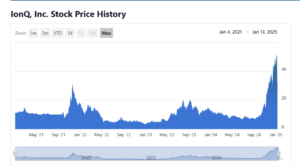
Understanding the IonQ forecast 2025 requires a careful analysis of its financial outlook. As a publicly traded company, IonQ’s financial performance is closely scrutinized by investors. Key metrics to consider include revenue growth, research and development expenses, and cash flow.
The company’s financial success depends on its ability to generate revenue from its quantum computing services and products. This revenue will be driven by factors such as the adoption of quantum computing by various industries and the competitiveness of IonQ’s technology. Investors will also be closely watching IonQ’s ability to manage its expenses and maintain a healthy balance sheet. The IonQ forecast 2025 is inextricably linked to these financial realities.
Key Financial Metrics to Watch
- Revenue Growth: Indicates the demand for IonQ’s quantum computing services.
- R&D Expenses: Reflects the company’s investment in future technological advancements.
- Cash Flow: Shows the company’s ability to fund its operations and investments.
- Gross Margin: Indicates the profitability of IonQ’s services.
Potential Challenges and Risks
The IonQ forecast 2025 is not without its challenges and risks. The quantum computing industry is still in its early stages, and there are many uncertainties about the future. Technological challenges, such as scaling up quantum computers and reducing error rates, could delay progress.
Competition from other quantum computing companies is also a significant risk. Companies like IBM, Google, and Rigetti are also investing heavily in quantum computing, and they could potentially develop superior technologies. Furthermore, regulatory and ethical concerns surrounding quantum computing could also impact the IonQ forecast 2025. [See also: Ethical Implications of Quantum Computing]
Potential Risks to the IonQ Forecast 2025
- Technological challenges in scaling up quantum computers
- Competition from other quantum computing companies
- Regulatory and ethical concerns
- Economic downturn impacting investment in quantum computing
- Geopolitical risks affecting international collaborations
Expert Opinions and Industry Analysis
To gain a comprehensive understanding of the IonQ forecast 2025, it’s important to consider the opinions of industry experts and analysts. Many experts believe that quantum computing has the potential to transform various industries, but they also caution that it will take time for the technology to mature.
Analysts’ forecasts for IonQ vary depending on their assumptions about the company’s technological progress, market adoption, and financial performance. Some analysts are optimistic about IonQ’s prospects, while others are more cautious. It’s important to consider a range of perspectives when evaluating the IonQ forecast 2025.
Conclusion: The Future of IonQ and Quantum Computing
The IonQ forecast 2025 is a complex and multifaceted topic. While there are many uncertainties about the future of quantum computing, IonQ is well-positioned to be a leader in this field. The company’s trapped-ion technology, strategic partnerships, and strong financial backing give it a competitive advantage.
However, it’s important to acknowledge the potential challenges and risks. Technological hurdles, competition, and regulatory concerns could impact IonQ’s progress. Ultimately, the IonQ forecast 2025 will depend on the company’s ability to overcome these challenges and capitalize on the opportunities presented by the rapidly evolving quantum computing landscape. The future of IonQ and the future of quantum computing are intertwined, making the IonQ forecast 2025 a crucial area of interest for investors, researchers, and industry professionals alike. The trajectory of IonQ will significantly shape the broader adoption and impact of quantum technologies, impacting numerous sectors from healthcare to finance. Keeping a close watch on IonQ’s advancements and strategic moves is essential for anyone seeking to understand the future of quantum computation. The success of IonQ will not only benefit the company itself but also pave the way for further innovation and development in the quantum computing ecosystem. The potential of IonQ to revolutionize industries is substantial, making the IonQ forecast 2025 a critical benchmark for progress in the field. Therefore, monitoring IonQ’s progress remains a vital activity for stakeholders across the board.
