Mastering the MACD RSI Strategy: A Comprehensive Guide for Traders
In the dynamic world of trading, combining different technical indicators can often lead to more robust and reliable signals. One such powerful combination is the MACD RSI strategy. This strategy leverages the strengths of both the Moving Average Convergence Divergence (MACD) and the Relative Strength Index (RSI) to provide traders with a clearer picture of market momentum, overbought/oversold conditions, and potential trend reversals. This comprehensive guide will delve into the intricacies of the MACD RSI strategy, offering insights into its components, implementation, and practical application.
Understanding the MACD Indicator
The Moving Average Convergence Divergence (MACD) is a trend-following momentum indicator that shows the relationship between two moving averages of a security’s price. It consists of the MACD line (calculated by subtracting the 26-period Exponential Moving Average (EMA) from the 12-period EMA), the signal line (a 9-period EMA of the MACD line), and the MACD histogram (which represents the difference between the MACD line and the signal line).
Traders use the MACD to identify potential buy and sell signals. A bullish crossover occurs when the MACD line crosses above the signal line, suggesting upward momentum. Conversely, a bearish crossover occurs when the MACD line crosses below the signal line, indicating downward momentum. The MACD histogram can also provide valuable insights; increasing histogram values suggest strengthening bullish momentum, while decreasing values indicate weakening bullish momentum or strengthening bearish momentum. Understanding these nuances is crucial when implementing the MACD RSI strategy.
Understanding the RSI Indicator
The Relative Strength Index (RSI) is a momentum oscillator that measures the speed and change of price movements. It oscillates between 0 and 100 and is primarily used to identify overbought and oversold conditions in the market. An RSI reading above 70 typically indicates that an asset is overbought and may be due for a correction, while an RSI reading below 30 suggests that an asset is oversold and may be poised for a bounce. The RSI can also be used to identify divergences, where the price makes new highs or lows, but the RSI fails to confirm these moves, potentially signaling a trend reversal. The RSI is an essential component of the MACD RSI strategy.
Combining MACD and RSI: The Synergy
The true power of the MACD RSI strategy lies in its ability to filter out false signals and provide more reliable trading opportunities. By combining the trend-following capabilities of the MACD with the overbought/oversold insights of the RSI, traders can gain a more comprehensive view of market conditions. For instance, a bullish MACD crossover accompanied by an RSI reading below 30 could signal a strong buying opportunity, as it suggests both upward momentum and oversold conditions. Conversely, a bearish MACD crossover with an RSI reading above 70 could indicate a potential selling opportunity.
Implementing the MACD RSI Strategy
To effectively implement the MACD RSI strategy, traders should follow a structured approach:
- Set up your charts: Configure your trading platform to display both the MACD and RSI indicators. Use standard settings (12, 26, 9 for MACD and 14 for RSI) initially, but feel free to experiment with different parameters to optimize the strategy for your specific trading style and market.
- Identify potential signals: Look for MACD crossovers (both bullish and bearish) and RSI readings above 70 or below 30.
- Confirm the signal: Before entering a trade, ensure that the signals from both indicators align. For example, a bullish MACD crossover should ideally be accompanied by an RSI reading below 30 or trending upwards from oversold levels. A bearish MACD crossover should be accompanied by an RSI reading above 70 or trending downwards from overbought levels.
- Set stop-loss orders: Protect your capital by placing stop-loss orders at strategic levels. For long positions, consider placing the stop-loss below a recent swing low. For short positions, place the stop-loss above a recent swing high.
- Determine profit targets: Establish realistic profit targets based on your risk tolerance and market conditions. You can use technical analysis tools like Fibonacci extensions or support and resistance levels to identify potential profit targets.
- Manage your trades: Continuously monitor your trades and adjust your stop-loss orders as the market moves in your favor. Consider taking partial profits along the way to lock in gains and reduce risk.
Example Scenarios
Bullish Scenario
Imagine a stock has been trending downwards for several weeks. The MACD line is below the signal line, indicating bearish momentum. However, the RSI falls below 30, suggesting that the stock is oversold. Suddenly, the MACD line crosses above the signal line, signaling a potential trend reversal. This bullish MACD crossover, combined with the oversold RSI reading, provides a strong signal to enter a long position. A trader using the MACD RSI strategy would see this as an opportune moment to buy.
Bearish Scenario
Consider a stock that has been rallying strongly. The MACD line is above the signal line, indicating bullish momentum. However, the RSI rises above 70, suggesting that the stock is overbought. The MACD line then crosses below the signal line, signaling a potential trend reversal. This bearish MACD crossover, combined with the overbought RSI reading, provides a strong signal to enter a short position. A trader utilizing the MACD RSI strategy would recognize this as a potential selling opportunity.
Advantages of the MACD RSI Strategy
- Improved signal accuracy: By combining two different indicators, the MACD RSI strategy helps to filter out false signals and provide more reliable trading opportunities.
- Comprehensive market view: The strategy offers a comprehensive view of market conditions by considering both trend-following and overbought/oversold aspects.
- Versatility: The MACD RSI strategy can be applied to various markets and timeframes, making it a versatile tool for traders.
Disadvantages of the MACD RSI Strategy
- Lagging indicators: Both MACD and RSI are lagging indicators, meaning they react to past price movements rather than predicting future ones.
- Whipsaws: In choppy or sideways markets, the MACD RSI strategy can generate false signals, leading to whipsaws and losses.
- Parameter optimization: The optimal settings for the MACD and RSI indicators may vary depending on the market and timeframe, requiring traders to continuously adjust and optimize the parameters.
Tips for Success with the MACD RSI Strategy
- Use confluence: Look for additional confirmation from other technical indicators or chart patterns to further validate the signals generated by the MACD RSI strategy.
- Practice risk management: Always use stop-loss orders and manage your position size to protect your capital.
- Backtest the strategy: Before implementing the MACD RSI strategy in live trading, backtest it on historical data to assess its performance and identify potential weaknesses.
- Stay disciplined: Stick to your trading plan and avoid making impulsive decisions based on emotions.
- Adapt to market conditions: Be prepared to adjust your strategy and parameters as market conditions change.
Advanced Techniques
Experienced traders often incorporate additional techniques to enhance the MACD RSI strategy:
Divergence Trading
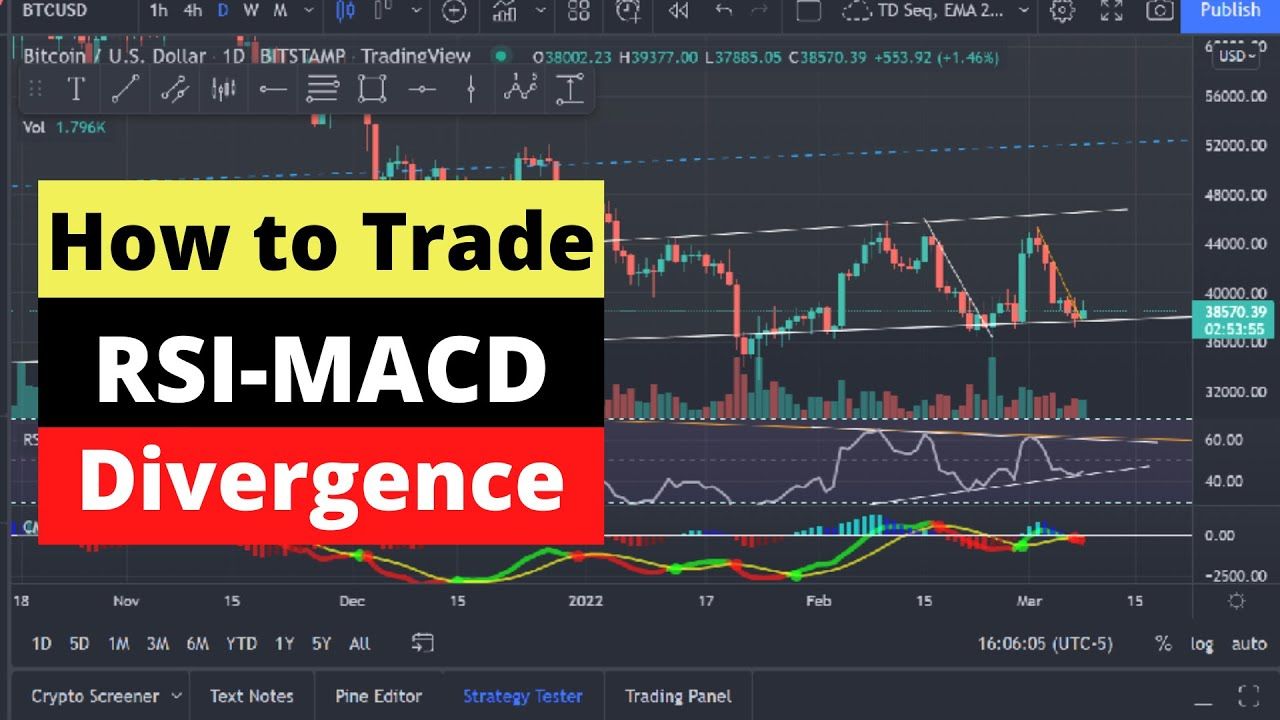
Look for divergences between price and the RSI or MACD. For example, if the price is making higher highs, but the RSI is making lower highs, it could signal a potential bearish reversal. Similarly, if the price is making lower lows, but the RSI is making higher lows, it could indicate a potential bullish reversal. Divergence trading can provide early warning signals of trend changes.
Using Moving Averages
Combine the MACD RSI strategy with moving averages to identify the overall trend direction. For example, if the price is above the 200-day moving average, consider only taking long positions based on the MACD and RSI signals. If the price is below the 200-day moving average, focus on short positions. This helps to trade in the direction of the prevailing trend.
Volume Confirmation
Pay attention to volume when confirming signals from the MACD RSI strategy. A bullish signal accompanied by increasing volume suggests strong buying interest, while a bearish signal with increasing volume indicates strong selling pressure. Volume confirmation can add an extra layer of validation to your trading decisions.
The Psychology of Trading with the MACD RSI Strategy
Trading psychology plays a crucial role in the successful implementation of any trading strategy, including the MACD RSI strategy. It’s essential to manage your emotions, avoid overtrading, and stay disciplined in following your trading plan. Fear and greed can lead to impulsive decisions and costly mistakes. Maintaining a calm and rational mindset is key to long-term success.
Conclusion
The MACD RSI strategy is a powerful tool that can help traders identify high-probability trading opportunities. By combining the strengths of the MACD and RSI indicators, traders can gain a more comprehensive view of market conditions and improve their trading performance. However, it’s important to remember that no trading strategy is foolproof, and the MACD RSI strategy is not immune to false signals and losses. Therefore, traders should always practice risk management and continuously refine their strategies to adapt to changing market conditions. With proper knowledge, discipline, and practice, the MACD RSI strategy can be a valuable asset in your trading toolkit. [See also: Understanding Technical Indicators for Day Trading] [See also: Best Trading Strategies for Beginners]
