Mutual Funds vs. Hedge Funds: Understanding the Key Differences
Navigating the world of investment can feel like traversing a complex maze, especially when faced with a plethora of options like mutual funds and hedge funds. Both are investment vehicles that pool money from multiple investors, but they operate under vastly different structures, strategies, and regulatory landscapes. Understanding these differences is crucial for making informed investment decisions. This article aims to provide a clear and concise comparison between mutual funds and hedge funds, helping you discern which option aligns best with your financial goals and risk tolerance.
What are Mutual Funds?
Mutual funds are investment vehicles that pool money from many investors to purchase a diversified portfolio of assets, such as stocks, bonds, or other securities. These funds are managed by professional money managers who aim to achieve a specific investment objective, which is outlined in the fund’s prospectus. Mutual funds are regulated by the Securities and Exchange Commission (SEC) and are required to adhere to strict guidelines regarding transparency and investor protection. They are known for their accessibility and relatively low minimum investment requirements, making them a popular choice for retail investors.
Key Characteristics of Mutual Funds
- Diversification: Mutual funds typically hold a wide range of assets, reducing the risk associated with investing in individual securities.
- Liquidity: Investors can buy or sell shares of mutual funds on any business day at the fund’s net asset value (NAV).
- Transparency: Mutual funds are required to disclose their holdings and performance regularly to investors.
- Regulation: Heavily regulated by the SEC, providing a level of investor protection.
- Accessibility: Generally accessible to a wide range of investors with relatively low minimum investment requirements.
What are Hedge Funds?
Hedge funds, on the other hand, are investment partnerships that employ a wider range of investment strategies, often including leverage, short-selling, and derivatives, to generate higher returns. Unlike mutual funds, hedge funds are not as heavily regulated and are typically only accessible to accredited investors – individuals or institutions with a high net worth and a sophisticated understanding of investment risks. Hedge funds aim to generate absolute returns, meaning they seek to profit regardless of the overall market direction. Their fee structures are also significantly different, often involving a combination of management fees and performance fees (e.g., “2 and 20”).
Key Characteristics of Hedge Funds
- Sophisticated Strategies: Employ complex investment strategies, including leverage, short-selling, and derivatives.
- Limited Regulation: Subject to less stringent regulations compared to mutual funds.
- Accredited Investors: Typically only accessible to accredited investors with high net worth and investment experience.
- Absolute Returns: Aim to generate positive returns regardless of market conditions.
- Higher Fees: Charge higher fees, including management fees and performance fees.
Mutual Funds vs. Hedge Funds: A Detailed Comparison
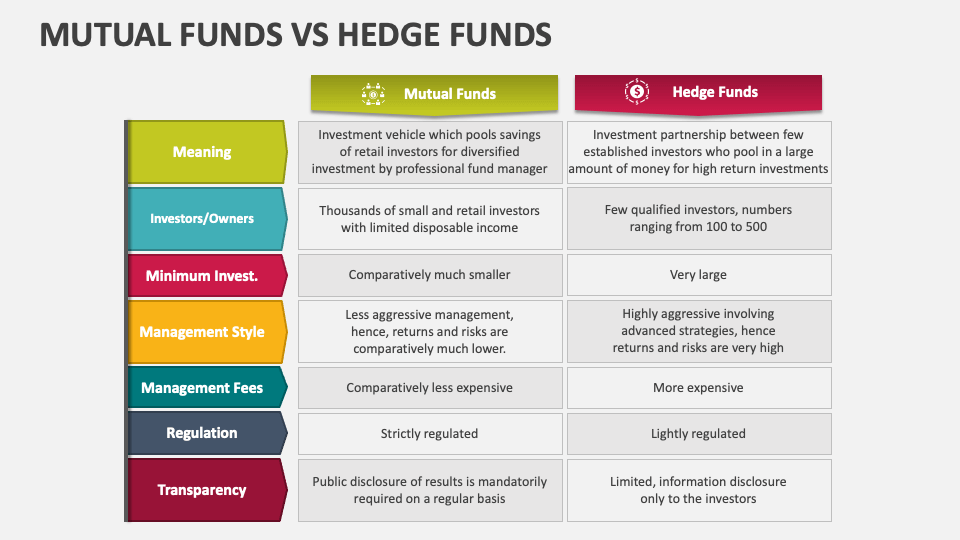
To further clarify the differences between mutual funds and hedge funds, let’s delve into a detailed comparison across several key aspects:
Investment Strategies
Mutual funds generally follow a more conservative and transparent investment approach. They typically invest in a diversified portfolio of stocks, bonds, or other securities that align with the fund’s stated objective. The strategies employed by mutual funds are usually less complex and more easily understood by the average investor. [See also: Understanding Investment Risk]
Hedge funds, in contrast, employ a much wider range of investment strategies, often involving leverage, short-selling, arbitrage, and derivatives. These strategies are designed to generate higher returns, but they also come with significantly higher risks. The complexity of hedge fund strategies can make them difficult for the average investor to understand.
Regulatory Oversight
Mutual funds are subject to stringent regulatory oversight by the SEC. These regulations are designed to protect investors by ensuring transparency, preventing fraud, and promoting fair market practices. Mutual funds are required to disclose their holdings, performance, and fees regularly to investors.
Hedge funds are subject to less stringent regulations compared to mutual funds. This is because hedge funds are typically only accessible to accredited investors who are presumed to have a higher level of investment sophistication and the ability to bear greater risk. While hedge funds are still subject to some regulations, they have more flexibility in terms of investment strategies and disclosure requirements.
Investor Accessibility
Mutual funds are generally accessible to a wide range of investors, with relatively low minimum investment requirements. This makes them a popular choice for retail investors who are looking to invest in a diversified portfolio of assets without having to manage their investments themselves. [See also: Investing for Beginners]
Hedge funds are typically only accessible to accredited investors, which include individuals with a high net worth (typically $1 million or more) or institutions with substantial assets. This limited accessibility is due to the higher risks associated with hedge fund investments and the less stringent regulatory oversight.
Fee Structures
Mutual funds typically charge management fees, which are a percentage of the fund’s assets under management (AUM). These fees are used to cover the costs of managing the fund, including salaries for the fund managers, research expenses, and administrative costs. Mutual funds may also charge other fees, such as sales loads (commissions) or redemption fees.
Hedge funds typically charge higher fees than mutual funds, often involving a combination of management fees and performance fees. A common hedge fund fee structure is “2 and 20,” which means the fund charges a 2% management fee and a 20% performance fee on any profits generated. These higher fees reflect the more complex investment strategies and the expectation of higher returns.
Liquidity
Mutual funds offer high liquidity, allowing investors to buy or sell shares on any business day at the fund’s net asset value (NAV). This liquidity makes mutual funds a convenient investment option for investors who may need to access their funds quickly.
Hedge funds typically have lower liquidity compared to mutual funds. Investors may be subject to lock-up periods, during which they cannot withdraw their funds. Additionally, hedge funds may have redemption restrictions, limiting the amount of money that can be withdrawn at any given time. This lower liquidity is due to the more complex investment strategies and the potential for large redemptions to disrupt the fund’s operations.
Choosing Between Mutual Funds and Hedge Funds
The decision of whether to invest in mutual funds or hedge funds depends on your individual circumstances, including your financial goals, risk tolerance, and investment experience. If you are a retail investor looking for a diversified and relatively low-risk investment option, mutual funds may be a suitable choice. Mutual funds offer accessibility, transparency, and liquidity, making them a convenient option for building a long-term investment portfolio.
If you are an accredited investor with a high net worth and a sophisticated understanding of investment risks, hedge funds may be an option to consider. Hedge funds offer the potential for higher returns, but they also come with significantly higher risks and lower liquidity. Before investing in a hedge fund, it is essential to carefully evaluate the fund’s investment strategy, track record, and fee structure.
Conclusion
Mutual funds and hedge funds are distinct investment vehicles that cater to different types of investors. Mutual funds offer diversification, liquidity, and transparency, making them a popular choice for retail investors. Hedge funds, on the other hand, employ more complex investment strategies and are typically only accessible to accredited investors. Understanding the key differences between these two investment options is crucial for making informed investment decisions and achieving your financial goals. The world of finance offers many paths; choosing between mutual funds and hedge funds is just one of the many important decisions you will make on your journey to financial freedom.
