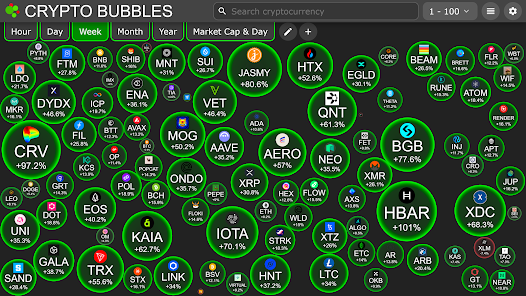
Navigating the Cryptobubbles: Understanding Market Cycles and Investor Strategies
The cryptocurrency market, known for its volatility and rapid innovation, is no stranger to boom-and-bust cycles often referred to as “cryptobubbles.” These periods of intense speculation and inflated prices are followed by sharp corrections, leaving many investors reeling. Understanding the dynamics of these cryptobubbles is crucial for anyone looking to participate in the crypto market without getting burned. This article explores the anatomy of a cryptobubble, the factors that contribute to its formation, and strategies investors can use to navigate these turbulent waters.
What is a Cryptobubble?
A cryptobubble is a speculative bubble specifically within the cryptocurrency market. Like any asset bubble, it is characterized by a rapid and unsustainable increase in the prices of cryptocurrencies, driven by hype, speculation, and often a lack of fundamental value. This surge is typically followed by a dramatic collapse, as the bubble bursts and investors rush to sell their holdings.
Several factors contribute to the formation of a cryptobubble:
- Hype and FOMO (Fear of Missing Out): Social media and online communities play a significant role in creating hype around certain cryptocurrencies. The fear of missing out (FOMO) drives investors to buy into the market, regardless of the underlying fundamentals.
- Limited Understanding: Many investors enter the crypto market without a thorough understanding of the technology, economics, or risks involved. This lack of knowledge makes them more susceptible to hype and speculation.
- Market Manipulation: The unregulated nature of some cryptocurrency exchanges allows for market manipulation, such as pump-and-dump schemes, which can artificially inflate prices.
- Low Interest Rates and Easy Money: Periods of low interest rates and easy access to credit can fuel speculative investments, including cryptocurrencies.
- Novelty and Innovation: The rapid pace of innovation in the crypto space can create excitement and attract investors to new projects, even if they are unproven.
Identifying a Cryptobubble
Recognizing a cryptobubble while it’s still inflating can be challenging, but several indicators can help you assess the situation:
- Unsustainable Price Growth: Prices are rising at an exponential rate, far exceeding any reasonable expectation based on fundamental value.
- Mainstream Media Attention: Cryptocurrencies are frequently featured in mainstream media outlets, often with sensational headlines.
- Irrational Exuberance: Investors are overly optimistic and confident, often dismissing any potential risks.
- New Investors Entering the Market: A large influx of new investors, often with limited experience, is entering the market.
- Increased Trading Volume: Trading volume is significantly higher than usual, indicating increased speculation.
- Shifting Narratives: The reasons for investing shift from fundamental value to speculative gains.
Historical Cryptobubbles
The cryptocurrency market has experienced several notable cryptobubbles throughout its history. One of the most significant was the 2017-2018 bubble, which saw Bitcoin’s price surge to nearly $20,000 before crashing dramatically. This bubble was fueled by the ICO (Initial Coin Offering) boom, with many projects raising significant amounts of capital without delivering on their promises. [See also: Understanding ICOs and Their Risks]
Another notable example is the DeFi (Decentralized Finance) boom of 2020-2021, which saw a surge in the prices of DeFi tokens. While DeFi has the potential to revolutionize the financial industry, many projects were overvalued, and the market eventually corrected. [See also: The Rise and Fall of DeFi: Lessons Learned]
Strategies for Navigating Cryptobubbles
Navigating cryptobubbles requires a disciplined approach and a focus on risk management. Here are some strategies investors can use:
- Do Your Research: Before investing in any cryptocurrency, thoroughly research the project, its team, its technology, and its potential use cases. Don’t rely solely on hype or social media sentiment.
- Understand the Fundamentals: Focus on cryptocurrencies with strong fundamentals, such as a solid team, a viable business model, and a clear value proposition.
- Diversify Your Portfolio: Don’t put all your eggs in one basket. Diversify your portfolio across different cryptocurrencies and asset classes to reduce your overall risk.
- Set Realistic Expectations: Don’t expect to get rich quick. The cryptocurrency market is highly volatile, and prices can fluctuate significantly.
- Use Stop-Loss Orders: Set stop-loss orders to limit your potential losses if the market turns against you.
- Take Profits: When prices rise significantly, consider taking profits to protect your gains. Don’t get greedy and hold on for too long.
- Dollar-Cost Averaging: Invest a fixed amount of money at regular intervals, regardless of the price. This can help you smooth out your average purchase price and reduce the impact of volatility.
- Stay Informed: Keep up-to-date with the latest news and developments in the cryptocurrency market. This will help you make informed investment decisions.
- Avoid Leverage: Using leverage can amplify your gains, but it can also amplify your losses. Avoid using leverage unless you fully understand the risks involved.
- Be Prepared to Hold: If you believe in the long-term potential of a cryptocurrency, be prepared to hold through periods of volatility. Don’t panic sell during market corrections.
The Psychology of Cryptobubbles
Understanding the psychology behind cryptobubbles is crucial for making rational investment decisions. Several psychological biases can influence investor behavior during these periods:
- Confirmation Bias: The tendency to seek out information that confirms your existing beliefs and ignore information that contradicts them.
- Herd Mentality: The tendency to follow the crowd and do what everyone else is doing, even if it’s not rational.
- Loss Aversion: The tendency to feel the pain of a loss more strongly than the pleasure of an equivalent gain.
- Overconfidence Bias: The tendency to overestimate your own abilities and knowledge.
- Anchoring Bias: The tendency to rely too heavily on the first piece of information you receive, even if it’s irrelevant.
By being aware of these biases, you can make more rational investment decisions and avoid getting caught up in the hype of a cryptobubble.
The Future of Cryptobubbles
While it’s impossible to predict the future, it’s likely that cryptobubbles will continue to occur in the cryptocurrency market. As the market matures and becomes more regulated, the frequency and severity of these bubbles may decrease. However, the inherent volatility of cryptocurrencies and the potential for speculation will always create the possibility of future bubbles.
Investors who understand the dynamics of cryptobubbles and implement appropriate risk management strategies will be better positioned to navigate these turbulent waters and potentially profit from the opportunities that arise. The key is to remain disciplined, informed, and rational, and to avoid getting caught up in the hype.
Conclusion
Cryptobubbles are an inherent part of the cryptocurrency market. Understanding their causes, identifying their characteristics, and implementing sound investment strategies are essential for long-term success in this volatile landscape. By focusing on fundamentals, managing risk, and avoiding emotional decision-making, investors can navigate these cycles and potentially benefit from the long-term growth of the cryptocurrency market. Remember that investing in cryptocurrencies involves significant risks, and you should only invest what you can afford to lose. Always do your own research and consult with a financial advisor before making any investment decisions.
