Retracement Meaning: Understanding Market Corrections and Trading Strategies
In the dynamic world of financial markets, understanding price movements is crucial for making informed trading decisions. One key concept traders and investors need to grasp is the retracement meaning. A retracement is a temporary reversal in the price of an asset that moves against the prevailing trend. It’s essentially a pullback or correction before the price resumes its original direction. Understanding retracement meaning is essential for identifying potential entry and exit points, managing risk, and optimizing trading strategies. This article delves into the intricacies of retracement meaning, exploring its significance, identification, and application in various trading contexts.
What is Retracement?
A retracement, sometimes referred to as a pullback or correction, is a short-term price movement that goes against the established trend. It’s a temporary dip or rise in price before the asset continues in its original direction. Understanding retracement meaning is crucial, as it allows traders to anticipate potential buying or selling opportunities. It’s important to note that a retracement is not a trend reversal. The overall trend remains intact, and the price is expected to continue in its initial direction after the retracement concludes.
Think of it like this: imagine a car driving uphill. The car may briefly roll backward slightly before continuing its ascent. This backward roll is analogous to a retracement in the financial markets.
Why Do Retracements Occur?
Retracements occur for a variety of reasons, often related to market psychology and profit-taking. Here are some common factors:
- Profit-Taking: When an asset’s price has risen significantly, some traders and investors may choose to take profits, leading to a temporary sell-off. This selling pressure can cause a retracement.
- Market Sentiment: Changes in market sentiment, such as negative news or economic data, can trigger a retracement. Even temporary shifts in investor confidence can lead to a pullback.
- Technical Factors: Certain technical levels, such as resistance or support levels, can act as barriers to price movement, causing a retracement.
- Overbought/Oversold Conditions: When an asset is overbought (price has risen too quickly), it’s often followed by a retracement. Similarly, an oversold asset (price has fallen too quickly) may experience a bounce-back.
Identifying Retracements
Several tools and techniques can help traders identify potential retracements:
Fibonacci Retracement Levels
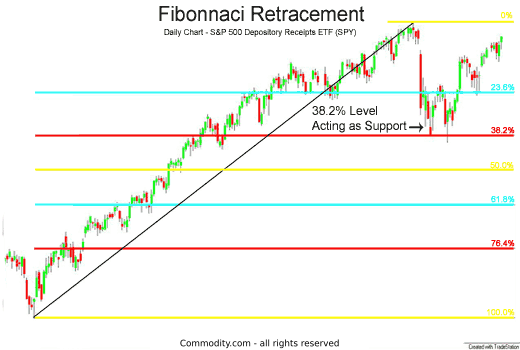
Fibonacci retracement levels are horizontal lines that indicate potential support and resistance levels where the price may pause or reverse. These levels are based on the Fibonacci sequence, a mathematical sequence found throughout nature. The most commonly used Fibonacci retracement levels are 23.6%, 38.2%, 50%, 61.8%, and 78.6%. Traders often look for price to retrace to these levels before resuming its original trend. Understanding retracement meaning is heavily linked to using these Fibonacci levels effectively.
To use Fibonacci retracements, identify a significant high and low point on a price chart. The Fibonacci tool will then automatically draw the retracement levels between those points. Traders then watch for price to interact with these levels, looking for potential buying or selling opportunities.
Trendlines
Trendlines are lines drawn on a chart connecting a series of highs (in a downtrend) or lows (in an uptrend). They can help identify the direction of the trend and potential areas of support or resistance. A retracement often occurs when the price pulls back to the trendline.
Moving Averages
Moving averages smooth out price data over a specified period, providing a clearer picture of the trend. When the price pulls back to a moving average, it can act as a support or resistance level, potentially signaling a retracement.
Candlestick Patterns
Certain candlestick patterns, such as doji, hammer, and engulfing patterns, can indicate potential reversals and retracements. These patterns provide visual clues about the balance between buying and selling pressure.
Trading Strategies Using Retracements
Understanding retracement meaning can be leveraged into several trading strategies. Here are a few common approaches:
Buying the Dip (Uptrend)
In an uptrend, a retracement presents an opportunity to buy the dip. Traders look for the price to pull back to a support level, such as a Fibonacci retracement level or a trendline, before entering a long position. The expectation is that the price will resume its upward trajectory.
Selling the Rally (Downtrend)
In a downtrend, a retracement offers a chance to sell the rally. Traders look for the price to bounce back to a resistance level before entering a short position, anticipating that the price will continue its downward trend. Understanding retracement meaning in a downtrend is just as crucial as in an uptrend.
Combining Retracements with Other Indicators
To increase the probability of success, traders often combine retracement analysis with other technical indicators, such as the Relative Strength Index (RSI) or Moving Average Convergence Divergence (MACD). This helps confirm the potential reversal and provides a more robust trading signal. For example, if the price retraces to a Fibonacci level and the RSI is oversold, it could be a strong indication of a buying opportunity.
Risks Associated with Retracement Trading
While retracement trading can be profitable, it’s important to be aware of the associated risks:
- False Signals: Not all retracements are genuine. Sometimes, a retracement can turn into a full-blown trend reversal.
- Whipsaws: The price can fluctuate rapidly during a retracement, leading to whipsaws, where traders are stopped out of their positions prematurely.
- Incorrect Identification: Accurately identifying retracements can be challenging, especially for novice traders.
Risk Management Techniques
Effective risk management is essential when trading retracements. Here are some key techniques:
- Stop-Loss Orders: Place stop-loss orders to limit potential losses if the trade goes against you. Set the stop-loss level below the support level (in an uptrend) or above the resistance level (in a downtrend).
- Position Sizing: Adjust your position size based on your risk tolerance and the volatility of the asset. Avoid risking too much capital on a single trade.
- Confirmation Signals: Wait for confirmation signals, such as candlestick patterns or indicator crossovers, before entering a trade. This helps reduce the risk of false signals.
Retracement vs. Reversal
It’s crucial to distinguish between a retracement and a trend reversal. A retracement is a temporary pullback within an existing trend, while a reversal signals a change in the overall trend direction. Misinterpreting a retracement as a reversal can lead to costly trading errors.
Here’s a table summarizing the key differences:
| Feature | Retracement | Reversal |
|---|---|---|
| Duration | Short-term | Long-term |
| Trend | Temporary pullback within an existing trend | Change in the overall trend direction |
| Impact | Minor price correction | Significant price shift |
| Confirmation | Trendline support/resistance, Fibonacci levels | Break of trendline, change in market structure |
Examples of Retracements in Different Markets
Retracements can be observed in various financial markets, including:
- Stocks: A stock in an uptrend may experience a temporary pullback due to profit-taking or negative news.
- Forex: A currency pair in a downtrend may experience a temporary rally due to economic data or market sentiment.
- Commodities: The price of oil, gold, or other commodities may experience retracements due to supply and demand factors.
- Cryptocurrencies: The highly volatile cryptocurrency market sees frequent and often dramatic retracements.
Conclusion
Understanding retracement meaning is fundamental for any trader or investor looking to navigate the financial markets effectively. By learning to identify potential retracements and employing appropriate trading strategies and risk management techniques, you can improve your chances of success. Remember to always conduct thorough analysis, combine retracement analysis with other indicators, and manage your risk diligently. While retracements offer opportunities, they also come with risks, so proceed with caution and continuous learning. Mastering the art of understanding retracement meaning will undoubtedly enhance your trading skills and contribute to your long-term success in the financial markets. [See also: Trend Following Strategies] [See also: Support and Resistance Levels] [See also: Fibonacci Trading Guide]
