Understanding the Liquidity Preference Model: A Comprehensive Guide
The liquidity preference model, a cornerstone of Keynesian economics, explains how individuals and businesses choose to hold their wealth in different forms, primarily cash versus interest-bearing assets like bonds. This model, developed by John Maynard Keynes, sheds light on the factors influencing interest rates and, consequently, macroeconomic activity. Understanding the dynamics of liquidity preference is crucial for investors, policymakers, and anyone interested in the workings of the financial system. This article delves deep into the liquidity preference model, exploring its components, implications, and relevance in today’s economic landscape.
The Essence of Liquidity Preference
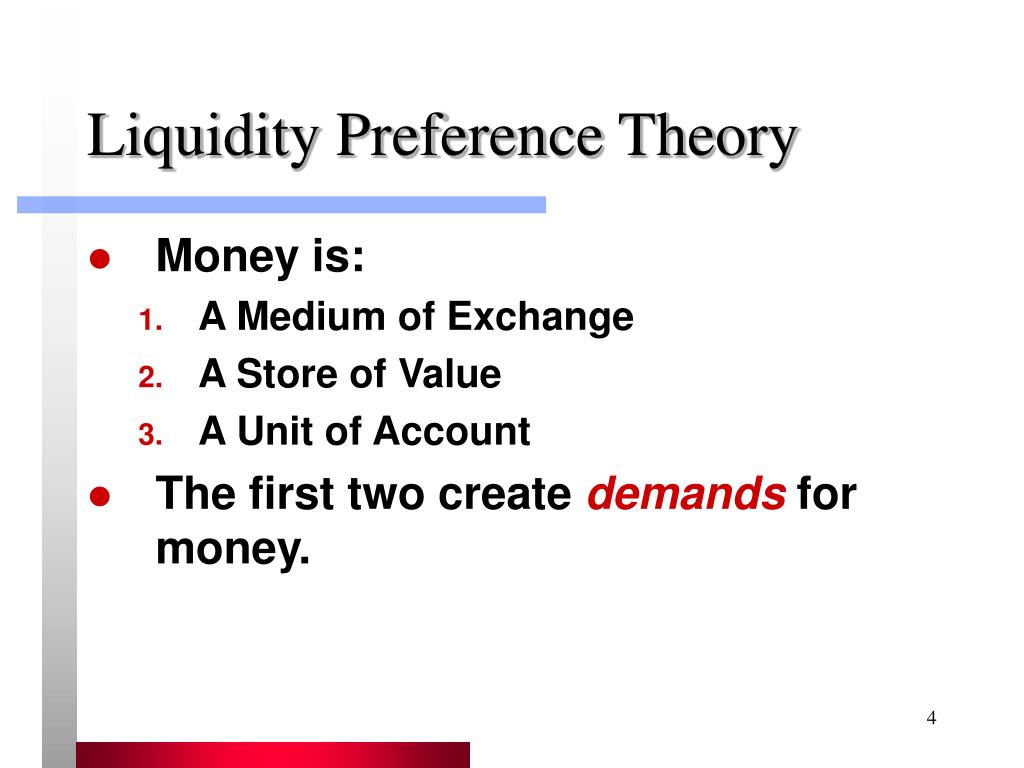
At its core, the liquidity preference model posits that individuals and businesses prefer to hold their wealth in the most liquid form possible – cash. This preference arises from the inherent advantages of cash, namely its immediate availability for transactions and its ability to provide a buffer against unexpected expenses. However, holding cash comes at a cost: the forgone interest that could have been earned by investing in other assets. The liquidity preference theory suggests that interest rates are determined by the supply and demand for money.
Motives for Holding Money
Keynes identified three primary motives driving the demand for money, each influencing the overall liquidity preference:
- Transaction Motive: This motive stems from the need to conduct everyday transactions. Individuals and businesses hold money to facilitate purchases of goods and services. The amount of money held for transaction purposes is directly related to the level of income. Higher incomes lead to more transactions and, consequently, a greater demand for money.
- Precautionary Motive: This motive arises from the desire to hold money as a buffer against unforeseen circumstances. Individuals and businesses hold a certain amount of cash to cover unexpected expenses or investment opportunities. The strength of the precautionary motive depends on the level of uncertainty in the economy and an individual’s or firm’s risk aversion.
- Speculative Motive: This motive is driven by expectations about future interest rates and asset prices. Individuals and businesses hold money if they believe that interest rates will rise or asset prices will fall. In this scenario, holding cash allows them to avoid capital losses and potentially profit from future investment opportunities. This speculative demand for money is inversely related to the current interest rate. The higher the interest rate, the lower the speculative demand for money, as the opportunity cost of holding cash increases.
The Supply of Money
While the demand for money is driven by the motives described above, the supply of money is typically controlled by the central bank. The central bank, through tools like open market operations, reserve requirements, and the discount rate, can influence the amount of money circulating in the economy. The liquidity preference model assumes that the money supply is exogenously determined by the central bank. The interaction of the money supply and the liquidity preference (demand for money) determines the equilibrium interest rate. [See also: Understanding Monetary Policy]
Equilibrium Interest Rate
The equilibrium interest rate is the rate at which the quantity of money demanded equals the quantity of money supplied. In the liquidity preference model, this equilibrium is graphically represented by the intersection of the money demand curve (liquidity preference curve) and the money supply curve. The money demand curve slopes downward, reflecting the inverse relationship between interest rates and the quantity of money demanded. The money supply curve is typically vertical, representing the central bank’s fixed supply of money.
Changes in either the supply or demand for money will shift the equilibrium interest rate. For example, an increase in the money supply, all else being equal, will shift the money supply curve to the right, leading to a lower equilibrium interest rate. Conversely, an increase in the demand for money (liquidity preference), perhaps due to increased uncertainty, will shift the money demand curve to the right, leading to a higher equilibrium interest rate.
Implications of the Liquidity Preference Model
The liquidity preference model has significant implications for macroeconomic policy and financial markets:
- Monetary Policy: The model provides a framework for understanding how monetary policy affects interest rates and, consequently, economic activity. By manipulating the money supply, the central bank can influence interest rates and stimulate or restrain economic growth. For example, lowering interest rates can encourage investment and consumption, boosting economic activity.
- Financial Market Analysis: The model helps investors understand the factors that influence interest rates and asset prices. By monitoring changes in the supply and demand for money, investors can anticipate movements in interest rates and adjust their investment strategies accordingly. Increased liquidity preference can signal potential market instability.
- Fiscal Policy: While primarily focused on monetary policy, the liquidity preference model also has implications for fiscal policy. Government borrowing can increase the demand for money, potentially driving up interest rates. This effect, known as crowding out, can reduce the effectiveness of fiscal stimulus.
Limitations of the Liquidity Preference Model
Despite its usefulness, the liquidity preference model has certain limitations:
- Simplified Assumptions: The model relies on simplified assumptions about the economy, such as a fixed price level and a closed economy. In reality, these assumptions may not hold, limiting the model’s accuracy.
- Ignores Other Factors: The model primarily focuses on the supply and demand for money as determinants of interest rates, neglecting other factors such as inflation expectations, credit risk, and global capital flows.
- Short-Term Focus: The model is primarily a short-term model and may not be suitable for analyzing long-term trends in interest rates.
Liquidity Preference in the Modern Economy
In today’s complex financial system, the liquidity preference model remains relevant but requires adaptation to account for new developments. For example, the rise of digital currencies and alternative payment systems has altered the landscape of money demand. Furthermore, globalization and the increasing integration of financial markets have made interest rates more sensitive to international capital flows. Central banks must consider these factors when implementing monetary policy. The liquidity preference of global investors can significantly impact national interest rates. [See also: The Impact of Globalization on Financial Markets]
Quantitative Easing and Liquidity Preference
Quantitative easing (QE), a monetary policy tool used by central banks during times of economic crisis, involves injecting liquidity into the financial system by purchasing assets such as government bonds. QE can be seen as an attempt to directly influence liquidity preference by increasing the supply of money and lowering interest rates. However, the effectiveness of QE depends on the extent to which individuals and businesses are willing to spend or invest the newly created money. If liquidity preference remains high, meaning that individuals and businesses prefer to hold onto cash, QE may have a limited impact on economic activity.
Conclusion
The liquidity preference model provides a valuable framework for understanding the determinants of interest rates and the role of monetary policy. While the model has limitations, it remains a crucial tool for economists, policymakers, and investors. By understanding the motives driving the demand for money and the factors influencing the supply of money, we can gain insights into the workings of the financial system and the forces shaping the economy. The concept of liquidity preference continues to evolve in response to changes in the financial landscape, making it essential to stay informed about the latest developments in monetary theory and practice. Understanding liquidity preference can help navigate complex financial decisions. The liquidity preference model is a fundamental tool for understanding macroeconomic dynamics, and its principles are crucial for navigating the complexities of modern finance. Properly assessing liquidity preference can lead to better investment decisions and a deeper understanding of economic trends. Consider the liquidity preference when making financial forecasts.
