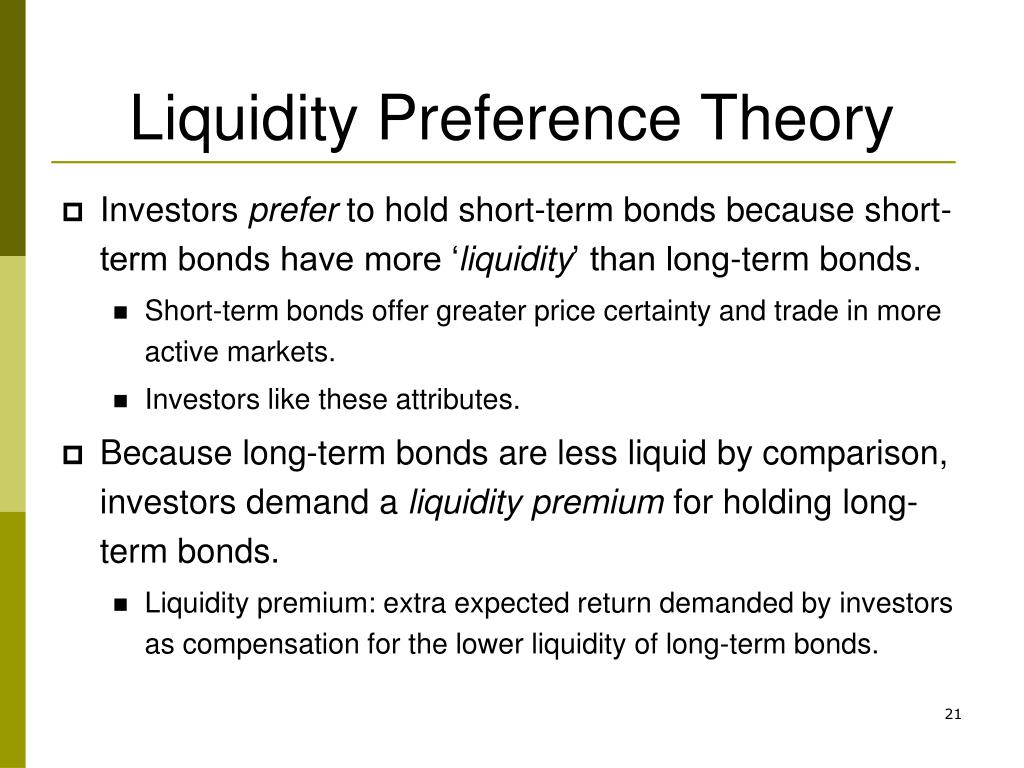
Understanding the Liquidity Preference Theory: A Comprehensive Guide
The liquidity preference theory, a cornerstone of Keynesian economics, explains how individuals and businesses decide to hold cash versus other forms of assets. This theory posits that interest rates are determined by the supply and demand for money. Understanding the nuances of the liquidity preference theory is crucial for comprehending macroeconomic policies and financial market behavior. This article delves into the intricacies of this theory, exploring its origins, key components, implications, and criticisms.
Origins of the Liquidity Preference Theory
The liquidity preference theory was introduced by John Maynard Keynes in his seminal work, “The General Theory of Employment, Interest and Money” (1936). Keynes challenged classical economic thought, which assumed that interest rates were determined by savings and investment. He argued that the demand for money, or liquidity preference, plays a pivotal role in shaping interest rates. Keynes observed that people prefer to have liquid assets, like cash, readily available for various reasons, influencing the equilibrium interest rate in the market.
Key Components of Liquidity Preference
The liquidity preference theory is built upon three primary motives for holding money:
The Transaction Motive
The transaction motive stems from the need to hold money to facilitate everyday transactions. Individuals and businesses require cash to purchase goods and services. The level of income and the frequency of transactions directly influence the amount of money held for this purpose. Higher income typically leads to greater spending and, consequently, a higher demand for money for transactions. Businesses also hold money to pay for supplies, wages, and other operational costs. This motive is relatively stable and predictable, as it is closely tied to economic activity.
The Precautionary Motive
The precautionary motive involves holding money as a buffer against unforeseen circumstances. Individuals and businesses hold cash to cover unexpected expenses or investment opportunities. The degree of uncertainty and risk aversion affects the amount of money held for precautionary reasons. During times of economic instability or uncertainty, the demand for precautionary balances tends to increase. People become more cautious and prefer to have extra cash on hand to deal with potential emergencies or take advantage of unexpected opportunities. This motive is less predictable than the transaction motive but remains a significant component of liquidity preference.
The Speculative Motive
The speculative motive arises from the desire to profit from future changes in interest rates or asset prices. Individuals and businesses may choose to hold money instead of investing in bonds or other assets if they believe that interest rates will rise or asset prices will fall. In this scenario, holding cash allows them to avoid potential losses and capitalize on more favorable investment opportunities in the future. The speculative motive is highly sensitive to expectations and market sentiment, making it the most volatile component of liquidity preference. When interest rates are low, people may expect them to rise, leading to increased demand for money and decreased investment in bonds. Conversely, when interest rates are high, people may expect them to fall, leading to decreased demand for money and increased investment in bonds.
The Role of Interest Rates
According to the liquidity preference theory, interest rates are the price of money. They represent the return or compensation required for parting with liquidity. When the demand for money increases, interest rates rise, and when the demand for money decreases, interest rates fall. This inverse relationship between the demand for money and interest rates is a central tenet of the theory. The supply of money, controlled by central banks, also plays a critical role in determining interest rates. When the money supply increases, interest rates tend to decrease, and when the money supply decreases, interest rates tend to increase. The equilibrium interest rate is the point at which the supply of money equals the demand for money.
Implications for Monetary Policy
The liquidity preference theory has significant implications for monetary policy. Central banks can influence interest rates by adjusting the money supply. By increasing the money supply, central banks can lower interest rates, stimulating economic activity. Conversely, by decreasing the money supply, central banks can raise interest rates, curbing inflation. However, the effectiveness of monetary policy can be influenced by the shape of the liquidity preference curve. If the curve is relatively flat, changes in the money supply will have a smaller impact on interest rates. This situation is known as the liquidity trap, where further injections of money into the economy fail to lower interest rates or stimulate economic activity.
Understanding the liquidity preference of individuals and businesses is crucial for central banks when formulating monetary policy. For example, during economic downturns, people may increase their demand for money due to precautionary and speculative motives. This can lead to a decrease in investment and economic activity. In such cases, central banks may need to implement expansionary monetary policies to lower interest rates and encourage borrowing and spending.
Criticisms of the Liquidity Preference Theory
While the liquidity preference theory has been influential, it has also faced criticisms. One criticism is that it oversimplifies the determinants of interest rates. Critics argue that other factors, such as savings, investment, and fiscal policy, also play significant roles in shaping interest rates. Additionally, some economists argue that the speculative motive is not as important as Keynes suggested. They contend that individuals and businesses are more influenced by long-term investment considerations than by short-term speculation. Another criticism is that the theory assumes that the demand for money is stable, which may not always be the case. Changes in technology, financial innovation, and institutional factors can affect the demand for money and make it more volatile.
The Liquidity Trap
A key concept related to the liquidity preference theory is the liquidity trap. This occurs when interest rates are already very low, and further increases in the money supply fail to stimulate economic activity. In a liquidity trap, individuals and businesses prefer to hold onto additional money rather than investing it, as they expect interest rates to rise or asset prices to fall. This can render monetary policy ineffective, as increasing the money supply has little or no impact on interest rates or economic activity. The liquidity trap is a particular concern during economic recessions or periods of deflation, when confidence is low and uncertainty is high. [See also: Understanding Monetary Policy Tools]
Real-World Examples
The liquidity preference theory can be observed in various real-world scenarios. For example, during periods of economic uncertainty, such as the 2008 financial crisis or the COVID-19 pandemic, the demand for money typically increases as individuals and businesses seek to hold more cash as a precautionary measure. This can lead to a decrease in investment and economic activity. Central banks often respond by implementing expansionary monetary policies, such as lowering interest rates and increasing the money supply, to stimulate economic growth. Another example is the behavior of investors during periods of rising interest rates. If investors expect interest rates to continue rising, they may choose to hold onto cash rather than investing in bonds, leading to a decrease in bond prices and an increase in interest rates. Understanding these dynamics is crucial for investors and policymakers alike.
Conclusion
The liquidity preference theory provides a valuable framework for understanding how interest rates are determined by the supply and demand for money. While it has faced criticisms and may not fully capture the complexities of modern financial markets, it remains a cornerstone of Keynesian economics and continues to inform monetary policy decisions. By understanding the three motives for holding money—transaction, precautionary, and speculative—individuals and businesses can better navigate the economic landscape and make informed financial decisions. Policymakers can use the liquidity preference theory to assess the effectiveness of monetary policy and respond to economic challenges. A thorough grasp of this theory is essential for anyone seeking to understand the dynamics of money, interest rates, and economic activity. The liquidity preference theory continues to evolve as economists refine their understanding of financial markets and the behavior of economic actors. This theory emphasizes the importance of liquidity preference in determining interest rates, highlighting the role of money demand. Further research and analysis will continue to shape our understanding of this fundamental concept in economics. The influence of liquidity preference on investment decisions and economic stability cannot be overstated.
