Understanding the Theory of Liquidity Preference: A Comprehensive Guide
The theory of liquidity preference, a cornerstone of Keynesian economics, provides a framework for understanding how interest rates are determined in the short run. Developed by John Maynard Keynes, this theory posits that interest rates are primarily influenced by the supply and demand for money. In essence, it explains why people prefer to hold liquid assets (money) rather than illiquid assets, and how this preference affects the prevailing interest rates. This article will delve into the intricacies of the theory of liquidity preference, exploring its underlying assumptions, key components, and practical implications.
What is the Theory of Liquidity Preference?
At its core, the theory of liquidity preference suggests that the interest rate adjusts to balance the supply and demand for money. People demand money for various reasons, including transactionary purposes (to make everyday purchases), precautionary purposes (to cover unexpected expenses), and speculative purposes (to profit from future interest rate changes). The supply of money, on the other hand, is largely controlled by the central bank of a country, such as the Federal Reserve in the United States.
The theory of liquidity preference offers a succinct explanation of short-run interest rate fluctuations. It is essential to clarify at the outset that this theory concentrates on the short-term dynamics of interest rates, distinct from the long-term perspectives offered by classical economic models. While long-term models may emphasize factors like savings and investment, the theory of liquidity preference homes in on the immediate interplay of money supply and demand.
The Demand for Money
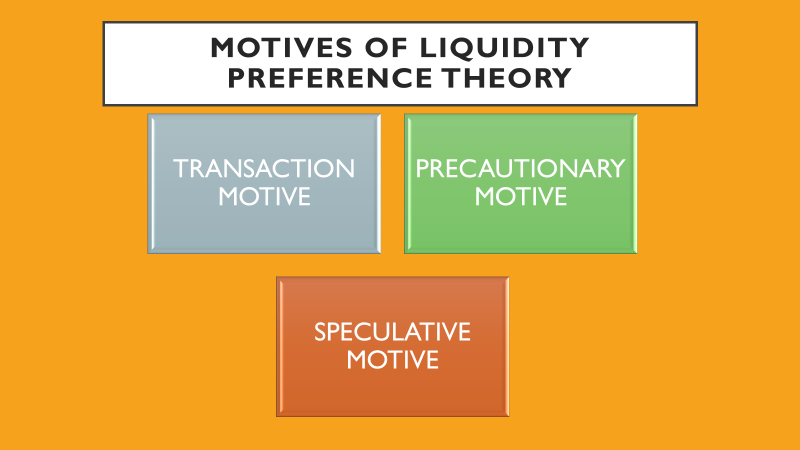
Understanding the demand for money is crucial to grasping the theory of liquidity preference. Keynes identified three primary motives for holding money:
Transactionary Motive
The transactionary motive is perhaps the most straightforward. Individuals and businesses need money to conduct day-to-day transactions. The amount of money demanded for this purpose is directly related to the level of income. As income increases, so does the demand for money to facilitate more transactions. This is a fundamental driver of money demand.
Precautionary Motive
The precautionary motive stems from the uncertainty of future events. People hold money as a buffer against unforeseen circumstances, such as medical emergencies or unexpected job loss. The demand for money for precautionary purposes is also influenced by income, as wealthier individuals may prefer to hold larger precautionary balances. Risk aversion also plays a role; those who are more risk-averse tend to hold more money for precautionary reasons.
Speculative Motive
The speculative motive is the most complex and arguably the most interesting aspect of the theory of liquidity preference. It arises from the belief that future interest rates may change. Individuals hold money speculatively when they expect interest rates to rise. They prefer to hold money now, waiting for interest rates to increase, so they can later invest in bonds or other interest-bearing assets and earn a higher return. Conversely, if they expect interest rates to fall, they will reduce their money holdings and invest in interest-bearing assets immediately.
The speculative demand for money is inversely related to the interest rate. When interest rates are high, the opportunity cost of holding money (i.e., the interest foregone) is also high, so people prefer to hold less money. When interest rates are low, the opportunity cost of holding money is low, so people prefer to hold more money. This inverse relationship is a key component of the theory of liquidity preference.
The Supply of Money
The supply of money, in the context of the theory of liquidity preference, is assumed to be fixed and determined by the central bank. The central bank controls the money supply through various tools, such as open market operations, reserve requirements, and the discount rate. Open market operations involve the buying and selling of government bonds. Buying bonds increases the money supply, while selling bonds decreases it. Reserve requirements are the fraction of deposits that banks are required to hold in reserve. Lowering reserve requirements increases the money supply, while raising them decreases it. The discount rate is the interest rate at which commercial banks can borrow money directly from the central bank. Lowering the discount rate increases the money supply, while raising it decreases it.
For the purposes of the theory of liquidity preference, the money supply is often considered to be a vertical line on a graph, indicating that it is independent of the interest rate. This simplification allows us to focus on the demand side of the equation and how changes in money demand affect the equilibrium interest rate. However, in reality, the money supply can be somewhat responsive to interest rate changes, particularly in the long run.
Equilibrium in the Money Market
The equilibrium interest rate is determined by the intersection of the money demand and money supply curves. At this point, the quantity of money demanded equals the quantity of money supplied. If the interest rate is above the equilibrium level, there will be an excess supply of money. People will try to get rid of their excess money holdings by buying bonds or other interest-bearing assets, which will drive down interest rates. Conversely, if the interest rate is below the equilibrium level, there will be an excess demand for money. People will try to obtain more money by selling bonds or other assets, which will drive up interest rates. The interest rate will continue to adjust until it reaches the equilibrium level, where the supply and demand for money are balanced.
Changes in either the money supply or the money demand will affect the equilibrium interest rate. An increase in the money supply will lower the equilibrium interest rate, while a decrease in the money supply will raise it. An increase in money demand will raise the equilibrium interest rate, while a decrease in money demand will lower it. These shifts in the equilibrium interest rate have significant implications for the economy.
Implications of the Theory of Liquidity Preference
The theory of liquidity preference has several important implications for understanding macroeconomic phenomena. Here are a few key points:
Monetary Policy
The theory of liquidity preference provides a theoretical basis for monetary policy. Central banks can influence interest rates by manipulating the money supply. By increasing the money supply, the central bank can lower interest rates, which can stimulate investment and consumption, leading to economic growth. Conversely, by decreasing the money supply, the central bank can raise interest rates, which can curb inflation. [See also: How Central Banks Control Inflation]
Fiscal Policy
The theory of liquidity preference also has implications for fiscal policy. Government spending and taxation can affect aggregate demand, which in turn can affect the demand for money. For example, an increase in government spending can lead to higher income, which can increase the transactionary demand for money and drive up interest rates. This effect is known as the crowding-out effect, where government borrowing pushes up interest rates, reducing private investment. Understanding this interaction is crucial for effective macroeconomic management.
Inflation
The theory of liquidity preference can help explain the relationship between money supply and inflation. According to the quantity theory of money, which is closely related to the theory of liquidity preference, an increase in the money supply leads to an increase in the price level (inflation). This is because more money chasing the same amount of goods and services drives up prices. While the relationship is not always straightforward, the theory of liquidity preference provides a framework for understanding how changes in the money supply can affect inflation.
Investment Decisions
Businesses consider interest rates when making investment decisions. Lower interest rates make borrowing cheaper, encouraging investment in new projects and expansions. Higher interest rates, conversely, increase borrowing costs, potentially deterring investment. The theory of liquidity preference helps to explain how these interest rate changes come about and how they impact the broader economy.
Criticisms and Limitations
While the theory of liquidity preference is a valuable tool for understanding short-run interest rate fluctuations, it is not without its criticisms and limitations. One common criticism is that it oversimplifies the money supply, assuming it is entirely controlled by the central bank and independent of interest rates. In reality, the money supply can be influenced by factors such as bank lending and international capital flows. [See also: Impact of Global Capital Flows on Domestic Interest Rates]
Another limitation is that the theory of liquidity preference focuses primarily on the short run and does not adequately address long-run determinants of interest rates, such as savings and investment. Classical economic models provide a more comprehensive framework for understanding long-run interest rate dynamics. Furthermore, the theory may not fully capture the complexities of modern financial markets, including the role of derivatives and other sophisticated financial instruments.
Conclusion
The theory of liquidity preference remains a fundamental concept in Keynesian economics, providing a valuable framework for understanding how interest rates are determined in the short run. By focusing on the supply and demand for money and the various motives for holding money, this theory offers insights into the effects of monetary and fiscal policy on the economy. While it has its limitations, the theory of liquidity preference continues to be a relevant and useful tool for economists and policymakers alike. Understanding the nuances of this theory is crucial for making informed decisions about economic policy and investment strategies.
