Unlocking Market Secrets: Mastering the Bollinger Squeeze for Trading Success
In the dynamic world of financial markets, traders and investors are constantly seeking reliable tools and strategies to identify potential opportunities and mitigate risks. Among the plethora of technical indicators available, the Bollinger Squeeze stands out as a powerful technique for spotting periods of low volatility that may precede significant price movements. This article delves into the intricacies of the Bollinger Squeeze, explaining its mechanics, interpretation, and practical applications in trading.
Understanding Bollinger Bands
Before diving into the Bollinger Squeeze, it’s crucial to understand the foundation upon which it’s built: Bollinger Bands. Developed by John Bollinger in the early 1980s, Bollinger Bands consist of three lines plotted on a price chart:
- Middle Band: A simple moving average (SMA), typically a 20-day SMA.
- Upper Band: The SMA plus two standard deviations of the price over the same period.
- Lower Band: The SMA minus two standard deviations of the price over the same period.
The standard deviation measures the amount of price variation relative to its average. When the price is highly volatile, the bands widen, and when the price is stable, the bands contract. This dynamic adjustment allows Bollinger Bands to adapt to different market conditions.
What is the Bollinger Squeeze?
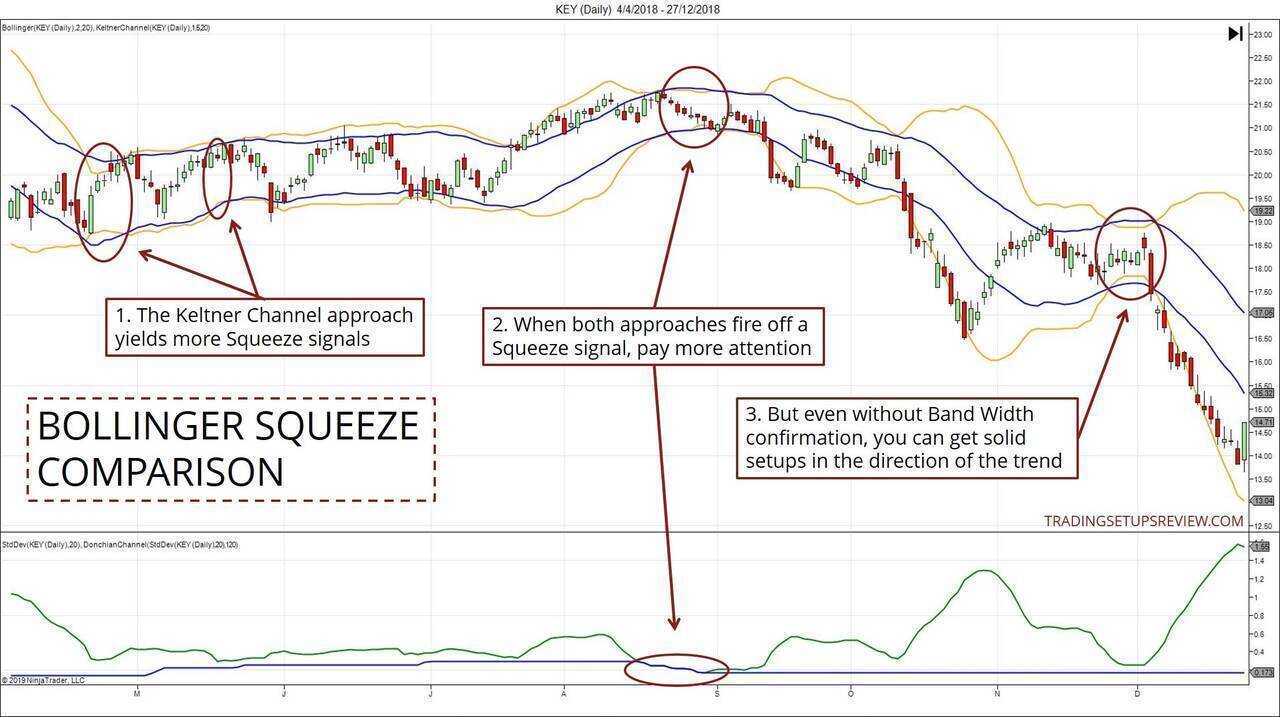
The Bollinger Squeeze occurs when the upper and lower Bollinger Bands come close together, indicating a period of low volatility. This contraction suggests that the market is consolidating and that a significant price movement is likely to occur soon. The underlying logic is that periods of low volatility are often followed by periods of high volatility, as the market prepares for a breakout or breakdown.
Think of it like a coiled spring. The tighter the spring is compressed, the more potential energy it stores. When released, this energy manifests as a rapid and powerful movement. Similarly, the Bollinger Squeeze signals that the market is building up energy for a substantial price swing.
Identifying the Bollinger Squeeze
Identifying a Bollinger Squeeze on a price chart involves visually assessing the distance between the upper and lower Bollinger Bands. A squeeze is confirmed when the bands narrow to their tightest point in a considerable time frame. However, simply identifying a squeeze is not enough; traders must also consider other factors to determine the direction and potential magnitude of the impending price movement.
There is no universally accepted threshold for defining a squeeze, but a common rule of thumb is to look for periods when the difference between the upper and lower bands is at its narrowest relative to recent historical data. Some traders use specific percentages or ratios to quantify the squeeze, but ultimately, it’s a subjective assessment based on visual inspection and experience.
Interpreting the Bollinger Squeeze
While the Bollinger Squeeze indicates that a significant price movement is imminent, it doesn’t predict the direction of that movement. To determine whether the price is likely to break out upwards or downwards, traders must consider additional factors, such as:
- Price Action: Analyze the price behavior leading up to the squeeze. Is the price trending upwards or downwards? Are there any significant support or resistance levels nearby?
- Volume: Look for increasing volume as the price approaches the squeeze. Rising volume can confirm the strength of the potential breakout.
- Other Technical Indicators: Use other technical indicators, such as moving averages, relative strength index (RSI), and moving average convergence divergence (MACD), to confirm the direction of the potential breakout. [See also: RSI Trading Strategies]
- Fundamental Analysis: Consider any relevant economic news, earnings reports, or other fundamental factors that could influence the price.
For example, if the price is trending upwards leading up to the squeeze and volume is increasing, it suggests that the price is likely to break out upwards. Conversely, if the price is trending downwards and volume is increasing, it suggests that the price is likely to break down downwards.
Trading Strategies Using the Bollinger Squeeze
Several trading strategies can be employed using the Bollinger Squeeze. Here are a few common approaches:
Breakout Strategy
This strategy involves waiting for the price to break out above the upper band or below the lower band after a Bollinger Squeeze. A breakout above the upper band is considered a bullish signal, while a breakout below the lower band is considered a bearish signal. Traders typically enter a long position when the price breaks above the upper band and a short position when the price breaks below the lower band.
Stop-loss orders are typically placed just below the low of the breakout bar for long positions and just above the high of the breakout bar for short positions. Profit targets can be set based on previous support and resistance levels or using other technical analysis techniques.
Volatility Expansion Strategy
This strategy focuses on profiting from the expected increase in volatility following a Bollinger Squeeze. Traders may use options strategies, such as straddles or strangles, to capitalize on the anticipated price movement, regardless of direction. A straddle involves buying both a call and a put option with the same strike price and expiration date, while a strangle involves buying a call and a put option with different strike prices.
The advantage of this strategy is that it can profit from significant price movements in either direction. However, it also carries the risk of losing money if the price doesn’t move significantly enough to offset the cost of the options.
Confirmation Strategy
This strategy involves waiting for confirmation from other technical indicators or fundamental factors before entering a trade after a Bollinger Squeeze. For example, traders may wait for the RSI to confirm an overbought or oversold condition or for a positive earnings report to confirm a bullish breakout.
By requiring additional confirmation, this strategy reduces the risk of false signals and increases the probability of a successful trade. However, it may also result in missed opportunities, as traders may not enter trades as quickly as they would with a pure breakout strategy.
Advantages and Disadvantages of Using the Bollinger Squeeze
Like any trading tool, the Bollinger Squeeze has its advantages and disadvantages:
Advantages:
- Early Warning Signal: The Bollinger Squeeze can provide an early warning signal of potential price movements, allowing traders to prepare for upcoming opportunities.
- Objective Indicator: Bollinger Bands are based on statistical calculations, making them relatively objective and easy to interpret.
- Versatile Application: The Bollinger Squeeze can be used in various markets and timeframes, making it a versatile tool for traders of all styles.
Disadvantages:
- False Signals: The Bollinger Squeeze can generate false signals, especially in choppy or sideways markets.
- Lagging Indicator: Bollinger Bands are based on past price data, making them a lagging indicator that may not accurately predict future price movements.
- Requires Confirmation: The Bollinger Squeeze should be used in conjunction with other technical indicators or fundamental analysis to confirm the direction of the potential breakout.
Real-World Examples
Consider a stock that has been trading within a narrow range for several weeks. The Bollinger Bands have contracted significantly, indicating a Bollinger Squeeze. As the price approaches the upper band, volume begins to increase, and the RSI moves into overbought territory. This confluence of factors suggests that the price is likely to break out upwards, and a trader might consider entering a long position.
Alternatively, imagine a cryptocurrency that has been trending downwards. The Bollinger Bands have narrowed, signaling a Bollinger Squeeze. As the price approaches the lower band, negative news emerges about the cryptocurrency’s regulatory status. This fundamental development confirms the bearish sentiment, and a trader might consider entering a short position.
Tips for Using the Bollinger Squeeze Effectively
To maximize the effectiveness of the Bollinger Squeeze, consider these tips:
- Use Appropriate Settings: Experiment with different settings for the moving average and standard deviation to find the optimal parameters for your trading style and the specific market you’re trading.
- Combine with Other Indicators: Don’t rely solely on the Bollinger Squeeze. Use it in conjunction with other technical indicators and fundamental analysis to confirm your trading decisions.
- Manage Risk: Always use stop-loss orders to limit your potential losses.
- Practice and Refine: Practice using the Bollinger Squeeze in a demo account before trading with real money. Refine your strategy based on your experience and results.
- Stay Informed: Keep up-to-date with market news and economic developments that could impact your trades.
Conclusion
The Bollinger Squeeze is a valuable tool for traders seeking to identify periods of low volatility that may precede significant price movements. By understanding the mechanics of Bollinger Bands, identifying squeezes, and considering other factors, traders can potentially profit from the increased volatility that typically follows a squeeze. However, it’s essential to remember that the Bollinger Squeeze is not a foolproof system and should be used in conjunction with other technical indicators and fundamental analysis to confirm trading decisions. With careful analysis, risk management, and continuous learning, traders can master the Bollinger Squeeze and unlock its potential for trading success.
Understanding the Bollinger Squeeze and how to apply it to your trading strategy can provide a significant edge in the market. Remember to always practice risk management and continue to learn and adapt to the ever-changing market conditions. The Bollinger Squeeze is just one tool in a trader’s arsenal, but it can be a powerful one when used correctly.
