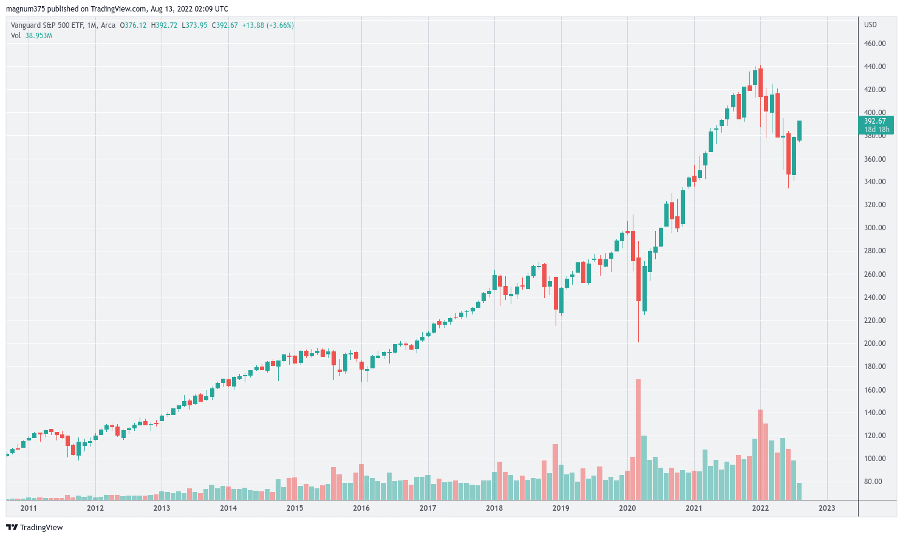
Vanguard S&P 500 ETF: A Comprehensive Guide for Investors
The Vanguard S&P 500 ETF (VOO) is a popular investment vehicle designed to mirror the performance of the Standard & Poor’s 500 Index, a benchmark representing 500 of the largest publicly traded companies in the United States. This exchange-traded fund (ETF) offers investors a simple and cost-effective way to gain broad exposure to the U.S. equity market. Understanding the nuances of the Vanguard S&P 500 ETF is crucial for making informed investment decisions. This article provides a comprehensive overview of VOO, covering its composition, benefits, risks, and how it fits into a diversified investment portfolio.
What is the Vanguard S&P 500 ETF (VOO)?
The Vanguard S&P 500 ETF (VOO) is an exchange-traded fund managed by Vanguard, one of the world’s largest investment management companies. VOO aims to track the investment results of the S&P 500 Index. It does this by holding stocks in the same proportion as the index. By investing in VOO, investors effectively own a small piece of each of the 500 companies included in the index. This provides instant diversification and reduces the risk associated with investing in individual stocks.
Key Features of the Vanguard S&P 500 ETF
- Broad Market Exposure: VOO provides exposure to a wide range of sectors and industries within the U.S. economy.
- Low Expense Ratio: Vanguard is known for its low-cost investment options, and VOO is no exception. Its expense ratio is exceptionally low, making it an attractive option for cost-conscious investors.
- Diversification: Investing in VOO allows investors to diversify their portfolios with a single investment, reducing the need to research and purchase individual stocks.
- Liquidity: As an ETF, VOO is highly liquid, meaning it can be easily bought and sold on major stock exchanges.
- Transparency: The holdings of VOO are publicly available, allowing investors to see exactly which companies they are invested in.
Benefits of Investing in the Vanguard S&P 500 ETF
There are several benefits to including the Vanguard S&P 500 ETF (VOO) in an investment portfolio:
Diversification
VOO offers instant diversification across 500 of the largest U.S. companies. This reduces the impact of any single company’s performance on the overall portfolio. Diversification is a cornerstone of sound investment strategy.
Low Cost
VOO’s extremely low expense ratio means that investors retain more of their returns. Over the long term, even small differences in expense ratios can have a significant impact on investment performance.
Simplicity
Investing in VOO is simple. Instead of researching and selecting individual stocks, investors can gain broad market exposure with a single purchase. This simplicity makes VOO an attractive option for both novice and experienced investors.
Tax Efficiency
ETFs are generally more tax-efficient than mutual funds. VOO’s structure helps to minimize capital gains taxes, potentially leading to higher after-tax returns for investors.
Long-Term Growth Potential
Historically, the S&P 500 has delivered strong long-term returns. By tracking this index, VOO offers investors the potential for significant capital appreciation over time.
Risks Associated with the Vanguard S&P 500 ETF
While the Vanguard S&P 500 ETF (VOO) offers numerous benefits, it’s essential to be aware of the associated risks:
Market Risk
VOO is subject to market risk, meaning its value can fluctuate based on overall market conditions. Economic downturns, geopolitical events, and changes in investor sentiment can all impact the performance of the S&P 500 and, consequently, VOO.
Concentration Risk
Although VOO is diversified across 500 companies, it’s still heavily weighted towards the largest companies in the index. This means that the performance of a few large companies can have a disproportionate impact on VOO’s overall return.
Tracking Error
While VOO aims to track the S&P 500 Index, it may not perfectly replicate its performance due to factors such as expenses and transaction costs. This difference is known as tracking error.
Inflation Risk
Inflation can erode the real value of investment returns. If the returns from VOO do not keep pace with inflation, investors may experience a decrease in purchasing power.
How to Invest in the Vanguard S&P 500 ETF
Investing in the Vanguard S&P 500 ETF (VOO) is straightforward. Here are the steps:
- Open a Brokerage Account: You will need a brokerage account to buy and sell ETFs. Many online brokers offer commission-free trading of ETFs, including VOO.
- Fund Your Account: Deposit funds into your brokerage account using methods such as electronic transfers, checks, or wire transfers.
- Search for VOO: Use the ticker symbol “VOO” to search for the Vanguard S&P 500 ETF on your broker’s platform.
- Place Your Order: Specify the number of shares you want to purchase and place your order. You can choose between different order types, such as market orders and limit orders.
- Monitor Your Investment: Regularly monitor the performance of your VOO investment and rebalance your portfolio as needed to maintain your desired asset allocation.
VOO vs. Other S&P 500 ETFs
While VOO is a popular choice, there are other ETFs that track the S&P 500 Index. Two notable alternatives are the SPDR S&P 500 ETF Trust (SPY) and the iShares Core S&P 500 ETF (IVV). Here’s a brief comparison:
- SPY (SPDR S&P 500 ETF Trust): SPY is the oldest and most actively traded S&P 500 ETF. It typically has a slightly higher expense ratio than VOO.
- IVV (iShares Core S&P 500 ETF): IVV is another low-cost option that tracks the S&P 500. Its expense ratio is similar to VOO.
The choice between these ETFs often comes down to personal preference. VOO and IVV are generally favored by cost-conscious investors due to their low expense ratios. SPY may be preferred by traders who value its high liquidity.
Incorporating VOO into Your Investment Portfolio
The Vanguard S&P 500 ETF (VOO) can be a valuable component of a diversified investment portfolio. Here are some strategies for incorporating VOO:
Core Holding
VOO can serve as a core holding in a portfolio, providing broad exposure to the U.S. equity market. This can be complemented with other asset classes, such as bonds, international stocks, and real estate.
Dollar-Cost Averaging
Dollar-cost averaging involves investing a fixed amount of money at regular intervals, regardless of market conditions. This strategy can help to reduce the impact of market volatility on your investment returns. [See also: Understanding Dollar-Cost Averaging]
Rebalancing
Regularly rebalance your portfolio to maintain your desired asset allocation. This involves selling assets that have outperformed and buying assets that have underperformed. Rebalancing can help to manage risk and improve long-term returns. [See also: Portfolio Rebalancing Strategies]
The Vanguard S&P 500 ETF: A Long-Term Perspective
The Vanguard S&P 500 ETF (VOO) is designed for long-term investors who seek to track the performance of the U.S. equity market. While short-term market fluctuations are inevitable, VOO offers the potential for significant capital appreciation over time. By understanding its key features, benefits, and risks, investors can make informed decisions about incorporating VOO into their portfolios. Consider consulting with a financial advisor to determine if VOO is the right investment for your individual circumstances.
Conclusion
The Vanguard S&P 500 ETF (VOO) provides a simple, cost-effective, and diversified way to invest in the U.S. stock market. Its low expense ratio, broad market exposure, and liquidity make it an attractive option for both novice and experienced investors. However, it’s important to be aware of the associated risks, such as market risk and concentration risk. By carefully considering your investment goals and risk tolerance, you can determine whether VOO is the right fit for your portfolio. Investing in the Vanguard S&P 500 offers exposure to the largest companies in the US, making it a stable long-term investment. The Vanguard S&P 500 ETF remains a solid choice for investors looking for broad market exposure. Understanding the Vanguard S&P 500 is key to smart investing. For many, the Vanguard S&P 500 is a cornerstone of their portfolio. With its diversity and low cost, the Vanguard S&P 500 is a great option. The Vanguard S&P 500 ETF is a powerful tool for building wealth. Consider the Vanguard S&P 500 for your investment needs. The Vanguard S&P 500 provides access to top US companies. The consistent performance of the Vanguard S&P 500 makes it a reliable choice.
